
Act I — The Crossing
Page 5 — Uuaellaen Holds the Line
It was Uuaellaen who held us. My blood brother. The cleric. The one I have called the one who holds the line for longer than I will say, and the name is true and I will not dress it.
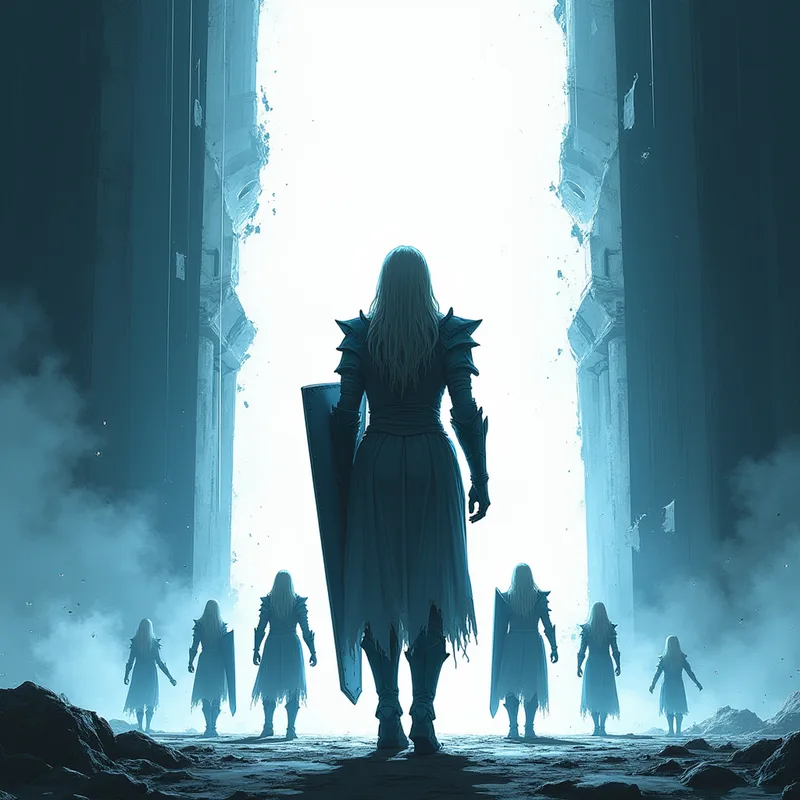
I will tell you what it was to stand in the middle of it, because I was there, and the record is owed my part. I was in the circle of the ward, the six of us, and I was not above it the way an archmage is allowed to be in a story like this. I had my own weight in the white, my own hands open, my own craft under my ribs turning over like a sleeper in a dream. I have read records that put their archmagi in the gallery, and I have read enough of them to know the way they smell. This record will not.
In the white, where the world was trying to scatter the six of us the way the wind scatters a handful of salt — and I have seen the scattering done, the salt going every way at once, each grain whole and each grain alone — his ward was the one thing the white could not do. I want the record to be exact: the white did not break it. The white went around it. That is the difference, and the difference is the whole of the line.
I will give you the ward, because the ward is the record. It was a light of his own — low, even, without a color I could name. I have named colors my whole life; the naming is the craft, and the craft is the one I was owed before the falling. But the ward had no name. I have tried, in the sanctums and in the quiet of this universe, and the quiet here is a different color from the quiet of the old world. A light without a name is a light the world has not spent, and he put it there before the white, at the last of the old world, the way he puts everything — with the whole of himself, and that was the one thing the white did not take.
It went around the six of us the way a hand goes around a cup, and it did not let go.
I have held wards before. I have made them, in the halls where the gods sat and did not sit. I will say this plainly, because the plain is the record: I have never held one that cost the way that one cost.
The ward cost him.
I saw the cost the way you see the cost of a thing you are not going to ask back. His face, through the light, was the face of a man reading a letter he has read before — not with fear, and not with anger, and with neither. His hands were flat on the ground of the white, the way they were always flat, fingers a little spread, and the white went thin where his palms were, the way a word goes thin in the mouth of a man who has said it too many times. His eyes were on the white, and he was holding the six of us with the same patience he holds everything. There was nothing on his face that I could name. I want the record to be careful about that, because a record that names what his face did on that page is a record that lies.
I will tell you what he paid, because the record is owed it. The ward did not take his voice — his voice was there, low under the light, saying nothing I could hear, and the saying-nothing was the one thing I have kept of him from that page, because I have kept his silences longer than his words, and the keeping is the whole of my page in this story. It did not take his hands. The hands were flat, and the flat was the holding. It took the rest. The rest was the color of him. I have seen a man's color go — I saw it go in the sanctums, in a man I will not name, and I will not name him here, because the naming is the one thing I owe him, and I have not yet owed it — and I will not describe it a second time in this record. The ward took the color of Uuaellaen, and the taking was the one the white spent, and I owed it the seeing.
I will tell you what the ogre did while the ward held, because the record is owed his part. He did not raise his shield. The shield was in his hands, the grip under his palms, and he stood where the ward put him, the way a man stands when he has already finished the argument and is waiting for the rest of the world to catch up. The white came at the ward — I will call it coming at, because it did that, it came at it the way water comes at a bank, not once but all the time — and the ward held.
I will tell you what I did, because the record is owed my part, and I have stood in this page for a hundred years without putting my part in it, and that was a lying, and this record will not lie. I did not cast. I had the craft, and the craft was under my ribs, and the white did not take it, and I did not cast, because a man who casts in the middle of his brother's ward is a man who has not yet decided whether the ward is enough, and the deciding was Uuaellaen's to do alone. I held the shape of the story in my hands the way you hold a word you are not going to say, and the word I was not going to say was the word that would have made the ward mine. I did not say it. The ogre's hands did not move. The cleric's hands stayed flat.
When the ground came — the wrong ground, all at once and without apology — the ward finished.
It did not arrive. The ground came the way a sentence comes: all at once, and the whole of the sentence, and there was no border, no edge where the white ended and the ground began. The sand was under us the way sand is under a thing it has taken. The white went thin over the wrong ground, and the thinning was the last motion I saw of the old world. And where the ward had been there was the sand, and the sand took the five of us the way the sand takes everything.
I will tell you what I saw when the light went, because the seeing is the record. I saw it go the way a candle goes — not all at once, and all at once, the way a thing is when it is a thing. I saw his hands, and the hands were flat, and the light was already gone from around them. I saw his face, and the face was the face of a man reading a letter he has read before. And then the sand was where he had been, and the sand was the one thing that did not keep his shape, which is the one thing I want the record to be careful about, because I have kept his shape this long, and the sand did not.
I will not tell you what I counted, on that page.
I will tell you when I counted it — the third morning, by the fire, in the plain voice, because a camp that has a wrong count and does not say it is not a camp, and the not-saying was the whole of the first two days. I counted them standing, sitting, and in the dark before the fire. I counted them the way I count everything: not with the hand, with the knowing. And I counted the place where the sixth had been, because a count that does not count the place is a count the world takes back.
The count was five.
I did not say the number. I stood by the fire with the number in my mouth, and the number was the one I owed them, and I owed it to them by not saying it, because a number that is said is a number the world spends, and they did not owe it on the third morning. I said what the number was without the number. I said, we are not six.
The ogre did not say anything. He put his hands back over the grip, and that was the whole of his page that morning, because a man who takes his hands off the grip in the wrong ground is a man who has not yet decided whether the fight is worth having, and he had decided, and the deciding was the one thing he owed alone. The erudite looked at the fire. The woman looked at the sand, the way she looks at a word she does not know — without reaching for it, and without turning away from it. Smackage had his palm flat on the ground of the wrong ground, and the flat was the one he did not do on the first two mornings — Smackage does not get up — and I did not ask him what he found under it, because I know the way he finds, and the way he finds is the one I do not ask. Wreckreate was on his knees by the little water there was, reading it, and the reading was the one he owed.
I will tell you what I did after that, because the record is owed my part. I kept the seat. The camp had a place where Uuaellaen was — a place in the circle, a place by the fire, a place in the order of the walk, and a place in the count — and I kept it, the way you keep a word in your mouth for a hundred years, and the keeping is the whole of the page. I did not say that I kept it. I did not need to. The ogre walked past the place the way the ogre walks past everything — with the whole of the body, and the whole of the body was the one thing the ogre owed, and the owing was the line.
The fire burned, and the sand held, and the place where the sixth had been was the one thing the sand did not take, because the sand cannot take a place, and the not-taking was the one I owed, and the owing was the whole of the line. I have kept the seat of my brother longer than I will say. The name is true. I will not dress it.