Act I — The Crossing
Page 1 — Cold Open, the Threshold
I have counted the moments of it a great many times, and the count is always the same: there was the last breath of the old world, there was the falling, and there was nothing between them that I can give a name. I have tried to give it a name. A name is the part of a thing the world can hold, and there was nothing there that could be held. So the count stays at three, and the third is the one the record has to keep.
Let me begin where the record began, and begin carefully, because the careful is the whole of the first page.
We stood in a circle on the last plain of the old world — the plain with no name, the plain the maps had always left white — and the dark was coming up out of the south the way winter comes up when it means to stay. I was the archmage of the order, and I tell you that I stood with my hands open at my sides and my craft coiled under my ribs like a thing that does not know yet what it is going to do. To my left stood my blood brother, the cleric who holds the line — Uuaellaen, tall as a doorpost, his ward already humming low in his throat the way a bowstring hums before the arrow. To his left, the ogre, Rumzuck, with his shield on his back and his hands folded over its grip, the way he folds them when he is deciding whether a fight is worth having. Beyond him, the erudite, Wreckreate, who reads water, standing with his feet apart and his weight even on both of them, because a reader who stands on one leg cannot afford to be wrong. Beyond him, Zahlia, the woman whose hands can hold a word in the air, her palms flat and her fingers a little spread, the way she holds them when she is listening for something she does not expect. And the sixth of us stood where the light fell thinnest, with his back to the south, the way the sixth always stands.
I will not write the sixth name here, on the first page. I will write it later, where the fire is, because a name is a thing you owe to a place that can keep it, and the first page is not a place that keeps.
The dark reached the circle. I want the record to be exact about that, because it is the truest sentence I can give you, and I have spent a hundred years learning that the truest sentence is not the one that sounds the truest. A dark is a thing that does not reach. A dark is a thing that is, and it is, and it does not put its hand out. This put its hand out. It came over the plain and found the six of us the way a hand finds a thing it has been waiting to take, and the finding was the whole of the crossing, and the whole of it is the thing I have kept, because it is the only thing that is the same on both sides.
What came with the dark was not the dark. What came with the dark was white.
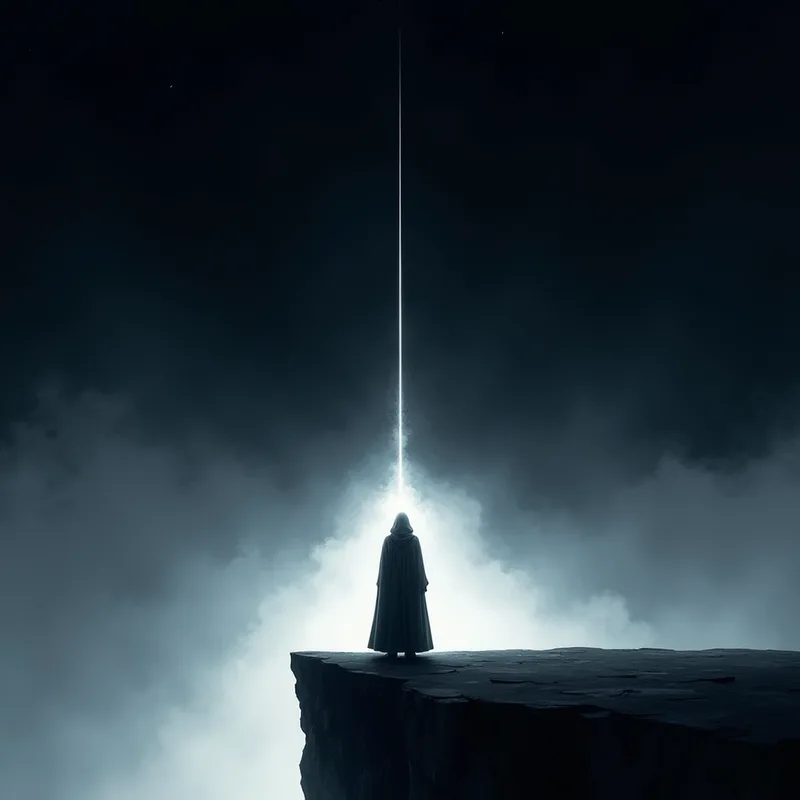
The light was white, and it was not a light you could look at — it was a light that looked. It rose out of the plain like a wall, and the wall leaned toward us, and the leaning was the last motion of the old world. I looked back at the light. I am the archmage, and I do not look back at lights — I look back at the shape of a thing that is doing something I have not seen it do before, and I will give you the shape: the shape was a hand, and the hand was the size of the plain, and the plain was the size of the world, and the hand was closing. The old world went down under it the way a house goes under a weight that has been put on it for a long time — not all at once, but all at once, the way a thing ends when it is finished. I felt the ground go out from under my feet, and the feeling went through me the way a bell goes through the air that has been struck, and the bell was the last sound of the old world, and the last sound was the one I have kept since the first page of it.
We were six in the white, all of us, mid-fall, and the falling did not hurt the way the falling should have. I want that to be plain: it did not hurt. A fall of that length, through a distance no measure could take, and the body did not do what bodies do. The air did not take our breath, and the breath did not need taking. I have held men through falls from towers, and the fall from a tower is a thing that does the hurting on the way down, and the hurting is the thing that tells you you are still a body. There was no hurting. There was only the white, and the smallness of us in it, and the six of us held in it the way a fist holds water — not touching, only near, the near of a flock near a fence it has not decided to cross. That is the first thing the wrong world taught us about itself: it does not do the hurt when it is due. I have been in this universe a while now, and the while has taught me that the not-doing-the-hurt is the one part of the world I do not trust, because a world that does not hurt you is not a world that owes you the hurt, and a world that does not owe you the hurt is not a world that owes you anything at all.
I will tell you what the archmage does in the white, because the doing is the record, and the record is owed the archmage's first page. I tried the planes. It is what I do — it is the first of the work — and the work is the one that does not lie. I put the hand of the asking out the way I put it out in the old world, in the old words, the words that have carried me through a hundred years of work, and I asked the water to come. The white did not answer. I asked the earth to answer. The white did not answer. I asked the air to move, and the air did not move, and I asked the fire to rise, and the fire did not rise, and the four of them were the four I have known since the first morning of the old world, and the four of them were not. I want the record to be exact: the planes were not silent the way a sleeping thing is silent. A sleeping thing answers later. The planes did not answer later. They were not there. So the archmage stood in the middle of the white with his hands open and his craft in him and no world to work it in, and the standing was the first of the new world's lessons, and the lesson is the one I keep.
I remember the cold. I have to say that, because the cold is the only part of the white that had a shape, and the shape was under my hands — a cold with edges, like the cold of a well at the bottom of a long summer. It did not spread. It stood still. It had a place, and the place was under my hands, and the standing-still was the one part of the white that behaved like a thing. I have held wards against colds I will not name, and the colds I will not name did not have edges, and the edges are the one part of the white I have kept the longest. A cold with edges is a cold that is a thing, and a thing that is a thing is a thing you can put your hand on, so I put my hand on it, and the putting-on was the one part of the white that felt like the old world.
I remember that my hands were open, and I do not remember opening them. I remember the weight of the other five near me — not touching, only near. Uuaellaen's ward was still around the six of us, low and even, without a color I could name, and I will tell you what it did not do: it did not go out. It held us near, the way a mill holds the water it is going to take. The ogre's hand was somewhere in the white, and I do not say that I saw it, because I did not see it — I felt it, the way you feel the hand of a man you have stood beside a hundred battles, and the feeling was the one the white did not do. It did not scatter us. The near was the same near for all of us, and the same was the one the white did not do, and the not-doing was the whole of the first page, and the whole of the page was the thing I have kept.
The Veil is thin there. Not thin as cloth. Thin as the space between one thought and the next, where nothing is kept and everything is allowed. We fell through it the way a word falls through a mouth. I will say the falling through, because the saying is the record: the Veil is the part of the world I have known longest — longer than the planes, longer than the craft, longer than the name I am given — and the Veil was the one part of the white that was not the white. I felt it the way you feel a door in a dark room: not with the hand, with the knowing, and the knowing was the one that was still mine. The thin place came, the thin place went, and the going was the whole of the Veil's part in the story, and the part is the one the record does not let go of.
I do not remember the white. I remember that I was in it, the six of us small against it, and I will say that plainly, because I have had the lying practice and I will not start with you. I have been in this universe a while now, and the while has taught me that the small is the one that is kept. A world that is large does not keep its small parts — the small parts are the ones it spends — and the keeping was the one the white did. We were small in it, the six of us, and the small was the one the record has to carry, because a story that begins small against the white is a story the white does not take back. I am the archmage, and I am the one who holds the shape of the story, and I will tell you the shape: the shape was a hand, and the hand was closing, and the six of us were small against it, and the small was the one the world did not do, and the not-doing was the whole of the first page, and the whole of the page was the thing the record keeps.