
Act III — The Split
Page 13 — The Gods Are Here and Not Answering
The sanctums are standing.
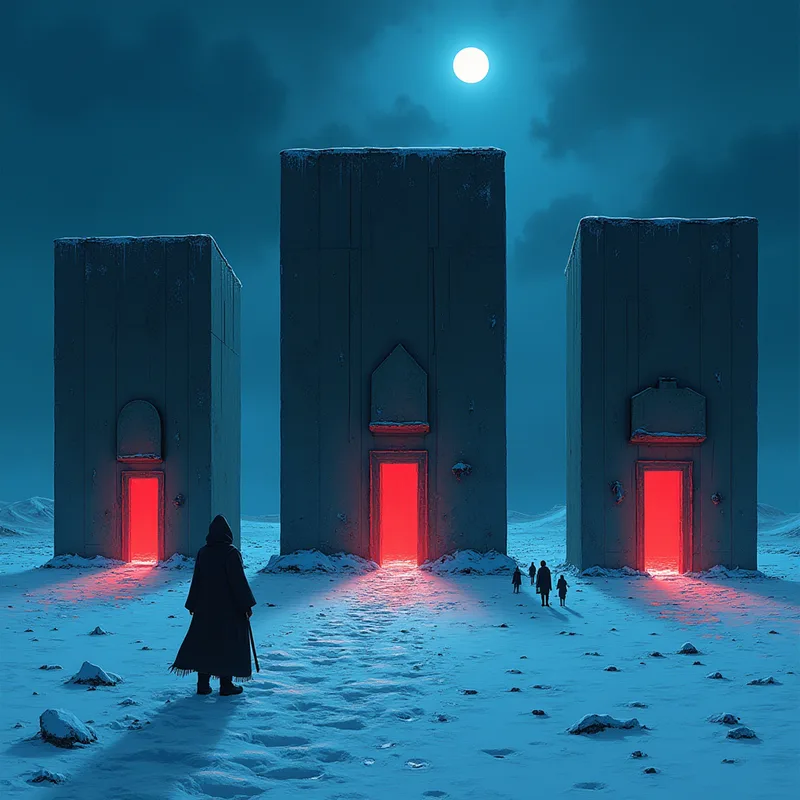
I have said it before, and I will say it again, because the saying is the thing that is true, and the true is the one the record keeps. The hall of seals holds its seals. The seals are the ones the gods put there, and the putting is the one the world does not let go of — the world here keeps the putting the way it keeps the words I speak, and the keeping was the courtesy the new world paid to the old order on the fifth morning, and the courtesy was the whole of the standing to me, and the whole is the one I have kept since I saw it from the broken line on the second morning.
The sanctums are standing where the sanctums should be.
I have looked. We looked — the five of us, all of us, standing on the black sand at the foot of the broken coast, looking the way you look at a thing that should not be standing and does not believe you. I want the record to keep the way of the looking, because the way is the one thing the thirteenth page is about, and the about is the work. The looking was not a looking that asked to be answered. It was a looking that refused. The sanctums stood, and the standing did not ask us to believe it, and the not-asking was the one thing the standing owed the looking, and the owing was the whole of the second morning's work, and the whole is the one the coast has kept since.
The stones are the stones of the old order.
I have known the stones since the first morning of the old world, and the first morning is the one the record does not spend on this page, because the spending is the work of the page that owes the first morning, and the page that owes it is not the thirteenth page. I will say only what the thirteenth page is owed: the stones are the stones, and the stones are the old order, and the old order is standing in the new world — the whole old order, every hall, every seal, every stone laid by hands that are not here — and the new world is not doing the standing.
That last part is the one the record is owed, and I will keep it plain, because the plain is the whole of the finding. The new world is not doing the standing. The sanctums are not growing out of this ground the way a thing grows out of the ground it is in. They are standing in it the way a stone stands in a mouth — present, and not of the mouth, and the not-of-the-mouth is the one thing I saw when I looked the way the record says I looked, and the seeing is the thing I have kept against the fifth morning and every morning since.
And none of them answers.
The not-answering is the world's own face, and the face is the one the world keeps. I went to the hall of seals at the first grey of the fifth morning, and I went alone, and the alone was the one thing the hall owed the asking — a hall that is being asked is asked one at a time, and the one-at-a-time was the courtesy the old order kept for its priests, and the keeping was the whole of the alone to me, and the whole is the one I have carried to the door.
I put my hand on the seal.
The seal was cold. I want the record to keep the cold, because the cold was the first of the seal's manners, and the manners are the whole of the seal to a priest. The seal was the cold of a thing that has been standing in the air a long time, and the long-time was the one the seal kept for the hand, and the keeping was the whole of the touch. I did the thing I have done a thousand times in a thousand sanctums. I asked.
Not with words.
I will not write down the shape of the asking, because the shape is not a thing the record can keep, and a record that writes down what it cannot keep is a record that has already begun to lie. I will say only this, and I will say it the way the record says it: the asking went out of me the way it had gone out of me in a thousand sanctums, and the going-out was the work of the old world on my hand, and the work was owed the asking back, and the asking owed the seal its knocking. The way you knock on a door that is not supposed to be locked.
The seal held.
The seal did what seals do. The seal took the asking the way the seal takes the asking in every world that has ever had a sanctum — without breaking, without moving, without looking up, and the not-looking-up was the one thing the seal kept for the hand, and the keeping was the whole of the holding, and the whole was owed to the asking, so the asking is the record's. And behind the seal there was the silence.
I want the record to keep the silence, and I will keep it exact, because the exact is the one thing the thirteenth page is owed, and the owing is the work. The silence was not the silence of a god who is sleeping. I have heard that silence, in the old world, in the sanctum where I learned the asking, and the sleeping silence is the one I have kept since, and the keeping is the whole of the sleeping to me. The sleeping silence has a weight to it. The weight is the one that answers when it is asked — not now, later, but the later is already in the weight, and the being-in-the-weight is the whole of the sleeping, and the whole is the one a sleeping god owes the door.
This silence had no weight.
I will say that once more, because the once-more is the whole of the finding: this silence had no weight. No later in it. No answering kept for the asking. The silence was the silence of a room where someone has been, and is not — and I want the record to keep the has-been, because the has-been is the one thing the silence owed the door, and the owing was the whole of it. Someone has been in the room. The someone is the one the old order put in the sanctum, and the putting was the one the old world kept for the door, and the keeping was the whole of the old world's faith to me, and the whole is the one I have carried to this door.
And the is-not is not a going-away.
That is the thing the thirteenth page lives on, and the living-on is the work. A going-away leaves a door open. A god who leaves — who moves on, who is called, who turns away — leaves the door the way a man leaves a room he means to come back to: open, and the open is the one thing the leaving keeps for the return, and the keeping is the whole of the going-away, and the whole is the one a priest spends the rest of his life waiting for. This left the room. Not the door. The room. The seal is standing where the seal is standing, the hall is standing where the hall is standing, the stone is standing where the stone is standing — the whole old order is here, down to the last stone, and the being-here is the one thing the world does not let go of; but the room behind the last stone is the room where the someone has been and is not, and the is-not is the one thing the old order did not do, and the not-doing is the thing I have kept.
The gods are here.
I will say it the way the record says it: the gods are here, and the here is the one the world does not let go of. The seals are here, the halls are here, the stones are here, the old order is here in its entirety, on the black sand of a world that does not have a name, standing in the air the way a thing stands when it has been put there and has not been asked to be. And the not-answering is the whole of the world. The world that answers the planes with shaped heat and listening words and kept smoke. The world that took the coal's word and has not given it back. The world that kept the old order's stones the way it keeps everything — without looking up, and the not-looking-up was the one thing the world owed the old order, and the owing was the whole of the standing, and the whole is the thing I have kept.
The old pantheon is not dead.
I want the record to keep the not-dead, because the not-dead is the one thing the thirteenth page refuses. Dead is a thing a priest can work with. Dead is a going-away that has finished, and the finished is the one thing the dead owes the faith, and the owing was the whole of the priest's part in the old world. Dead is the silence with no weight AND the door closed AND the stone on the door — all three, and the three are the whole of the dead, and the whole is the one a priest can say over a sanctum and go home. This has none of the three. This has the room with no one in it, and the no-one is not the dead, and the not-dead is the one the thirteenth page keeps against every morning since the fifth, and the keeping is the work.
I came back to camp with the cold on my hand.
The four of them were where the four of them stand — Rumzuck with his hand on the boss, Smackage with his palm an inch above the sand, Zahlia with her face up, Wreckreate at the line where the water comes in — and I stood in the middle. I did not say what I had found. I will say why, because the why is the one the record is owed: the not-saying was not the fear. The not-saying was the craft. A priest does not say what the seal did not do until the priest has said what the seal did, and the saying-what-the-seal-did is the work of the thirteenth page, and the work is owed its page; the saying-what-the-seal-did-not-do is the work of the page that comes after, and the page that comes after is owed the saying whole, and the owing is the one I kept against the morning.
The sanctums are standing. The gods are here. And none of them answers.
I will leave the three of them standing there the way they stood when I left them: the standing is the here, the here is the world's keeping, and the keeping is the thing the fourteenth page is owed — the fourteenth page is owed the two readers, and the two readers are owed the water and the ground, and the water and the ground are the ones who will say what the seal did not do.