
Act II — First Ground
Page 11 — The First Fire
A campfire on the wrong world.
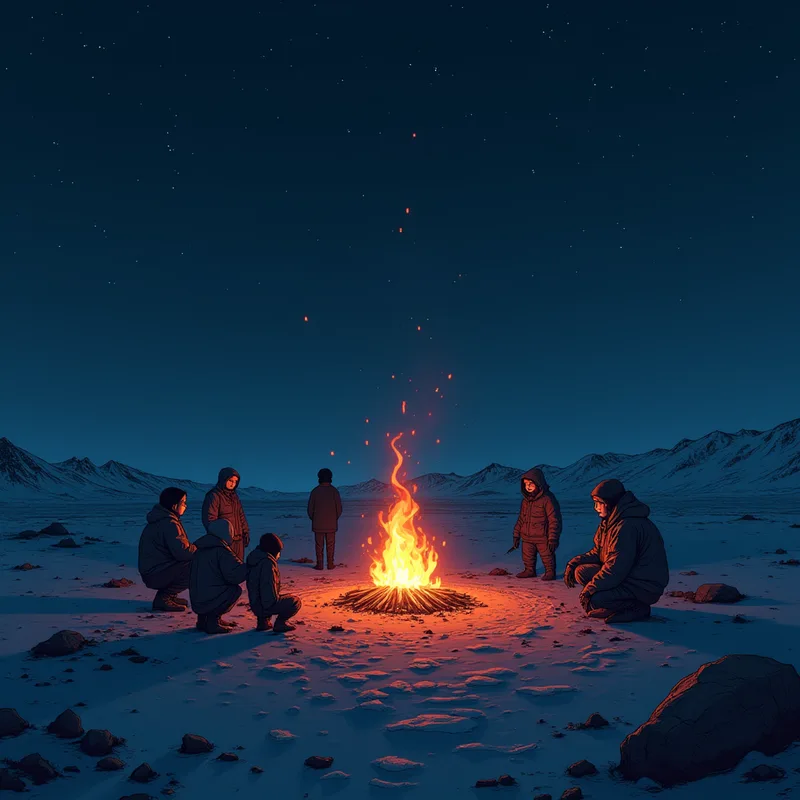
I want the record to keep the wrong, because the wrong is the one thing the eleventh page does not spend, and the not-spending is the whole of its opening. A campfire is the one thing a camp has that is not the world's, and on the third morning of a world that has not yet agreed to be ours, the fire was the one word the camp said that was not said to the world. It was said to each other. The saying was the whole of the first night, and the whole is the one thing the eleventh page keeps.
I will not tell you how we found the wood. I will tell you what the wood was, because the what is the record, and the record is owed the what. It was black — not the black of the rock, which is the black of a thing that has been broken and has not decided what to be; this was a different black, the black of a thing that has been kept. And it was dry in the wrong way. I have held dry wood in the old world, and the dryness there was a dryness the wood had earned — the sun had taken it, the wind had taken it, and the taking was the work of the world on the wood. This wood was dry the way a thing is dry when it has been kept rather than grown, and a wood that has been kept is a wood that has been waiting, and the waiting is the one thing I did not ask the wood to answer.
Smackage broke the first of it.
I want the record to keep the breaking, because the breaking was the first sound of our making in the new world, so I am recording it: the first sound was a hammer on black wood. Not a blow — the ground-reader is not a blow; he did not break it the way the ogre would have broken it, and the not-breaking-it-the-ogre-way was the quietest breaking I have heard a thing of that size give. He put the hammer on the wood the way he puts his palm on the ground — an inch, and the listening, and then the breaking — and the breaking was the one sound that went out over the black sand and the black water, and it came back to us the way a sound comes back when the world has not learned to take it.
The world had not learned to take it.
I want that plain, because the plain is the record. In the old world, a sound goes out and the world takes it — the trees take it, the walls take it, the distance takes it, and the taking was the work of the world on the sound. Here the sound went out and the world did not take it. The sound came back to us. Not an echo — I want the record to be careful, because an echo is a thing the world gives back, and the giving is the work of the world; this was not the world giving back. This was the world not taking. The sound stood out on the sand the way a word stands in a room no one has spoken in yet, and the standing was the one thing the third morning owed the camp, and the owing was the whole of the first sound, and the whole is the one thing the eleventh page keeps of the making.
The fire took a long time to be a fire.
I will record that too, because the long time was the first of the new world's lessons. The black wood does not give up its smoke the way wood should. In the old world the smoke came off the wood the way a word comes off a mouth that has been keeping the word a long time, little by little, and the little-by-little was the whole of the smoke. Here the smoke did not come off the wood little by little. The wood kept it. I watched it keep it — the black pieces sitting there, dry in the wrong way, keeping the smoke the way they had kept the dryness, and the keeping was the whole of the wood to me by the time the match had gone out three times.
Then it gave it up. All at once. The black wood gave up its smoke the way a thing gives up a word it has been keeping — not little by little, all at once, and then not at all. The smoke stood up out of the wood in one piece, the way a word stands up when the mouth has finally opened, and the standing-up was the whole of the match's third try. And then the not-at-all: the smoke stopped, because a word given up is a word the mouth does not keep, and the not-keeping was the whole of the wood's part in the making.
When the fire was a fire it was the fire, and I want the record to keep the when, because the when is the one thing the lesson is about. Here, the taking is slower than the giving. In the old world, the fire took the wood the way a world takes a sound — without looking up. Here the taking had to be done. The coals came up out of the black wood one at a time, and the one-at-a-time was the first of the new world's lessons: here, the taking is slower than the giving, and the slowness is the one thing the camp has to be built on, because a camp that builds on the speed of the old world will be built on a thing this world does not have.
The smoke went up, and the up was the one thing that was right.
I want that plain, and I want it kept, because the record is owed the plain on the night the first right thing happens. I have not written a right thing down since the gull — the gull is the work of the eighth page — and the not-writing was the whole of the night until the smoke went up. Up. Not out, not over, not the way the sound had stood on the sand; up. The smoke went up the way smoke goes in every world that has ever been, and the every-world was the one thing the new world owed the camp that night. I watched it go up, and the watching was the one work I did that night that was not the keeping of the record.
The five of us sat around it.
I say the five, and I will not count, because the counting is the work of the later page, and the later page is owed the count whole. The camp sat around the fire, and the sitting was the first of the new world. The fire was the first thing that was ours, and I want the record to be exact about the difference, because the difference is the whole of the first night.
The sand was not ours. The black sand had taken us without looking up, and the not-looking-up was the whole of the sand to us that night. The air was not ours. The air had done what air does — it had come in — and the whole of the air had not included us. The dark that was coming was not ours. The dark came in from the water the way the dark had come in on the second night, and the whole of the coming-in had not included us.
The fire was.
A thing that is yours is a thing the world does not get back. I want the record to keep the getting-back, because the getting-back is the one thing the eleventh page is about. The world gets back the sand, the air, the dark — the world's-ness is the one thing each of them keeps. The world did not get back the fire. I watched the world try, and the trying was the one thing the record owes the fire: the wind came out of the water the way the wind comes out of water in every world, and the wind went over the fire the way the wind goes over fire in every world, and the fire did not go out, and the not-going-out was the one thing the world did not take, and the not-taking was the whole of the first night.
I will not tell you what we said by the first fire. I will tell you what we did not say, because the not-saying is the thing that is true, and the true is the one the record keeps.
We did not say the name of the world we had been in. I have the name in me, and the name is the one thing I have kept since the first morning of the old world; but the name was not said on the third morning of the new world, and the not-saying was the courtesy the camp kept for the old world, because a name said in the wrong world is a name the wrong world can hear, and the wrong world has ears I have not yet met.
We did not say the name of the world we were in. There is no name for it, and I want that plain, because the record is owed the plain on the night the camp learns the world it is in does not have a name. I have looked for the name the way I looked for the shape on the broken line — with the eyes, with the hands, with the craft — and the name is not there. The world does not have a name the way the rock does not have a shape. The world has the color, and the color is the one thing the world keeps where a name would go. The no-name is the one the world keeps, and the keeping is the one the eleventh page does not spend, because the spending is the work of the page that owes the name, and the page that owes the name is not the eleventh page.
The fire burned. The five of us were around it, and I will say it once more, because the once-more is the whole of the record: the camp was around the fire, and the around was the first of the new world. The first of the new world was not the sand, because the sand had not included us. The first of the new world was the around — the five of us, and the fire, and the smoke going up, and the dark not taking the fire.
The new world took it the way it takes everything — without looking up.
I want the record to keep the without-looking-up, because the without-looking-up is the one thing the eleventh page ends on. The world did not look up at the fire. The world took the fire the way the world takes everything on this coast — without looking up. But the fire was the one thing the taking did not take, and the not-taking was the whole of the fire, and the whole is the one thing the camp woke to on the fourth morning, and the waking is the work of the twelfth page, and the twelfth page is owed the air.