Act I — The Crossing
Page 6 — The Crossing
The Veil tore. I have written the word a hundred times and it is still the wrong word, but I will keep it, because it is the truest of the wrong ones. A tearing has a sound in every world that has ears, and there was no sound. I have checked the record for the sound, and the sound is not there, and the not-there is the one I keep.
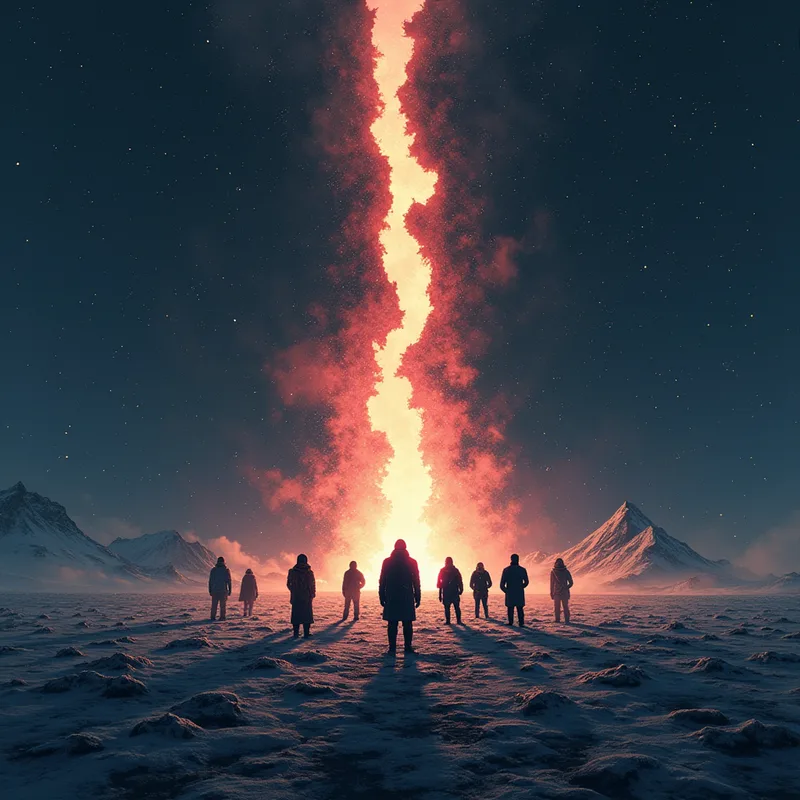
I will tell you what I heard instead, because the record is owed the hearing. I heard the ogre breathe. He breathes the way a bell breathes — the whole of the body in, the whole of the body out, and the bell does not hold its breath for the sound it is about to be. He was steady. A man who breathes steady in a tearing has already finished the argument, and the ogre had finished it long before the tearing reached the white. I heard Wreckreate's lips move. He was counting — he counts before he reads, the way a man counts his own heartbeats before he dives into a river he has not tested — and the counting was for the water he had not yet seen. I heard Smackage not move at all. I want the record to be careful about that. A man who does not move in a tearing is not a man who is calm, and a record that writes calm where it should write the not-moving is a record that lies. I heard Zahlia's breath go thin. Her breath goes thin when the air is about to be asked a question, and the tearing was about to ask one.
And I heard myself. I will say that plainly. My breath was not steady. It was the breath of a man holding a shape, and the shape was the one I was owed, and the owing was the whole of my page in this crossing.
It was not a door. A door is a place where a world has decided to be crossed. A door has a side, and the side is the whole of the door — the outside that knocks, and the inside that does not. This had no side. This was a wound — the place where a world has been broken and has not decided what to do about it yet. A wound does not let you in. A wound lets you through, and the letting-through is not a doing, and the not-doing is the thing I have kept.
I have looked at a hundred wounds, and the looking is the one I was owed, and the owing was the whole of my page in the old world. A wound in a man is a place where the world has been broken in the man, and I have kept such looking since the first page of my keeping. But this wound was not in a man, and a wound in a world is a different thing from a wound in a man, and the difference is the whole of the crossing. It had no edge I could put my hand on: I put my hand out once, in the white, and the hand found no edge, and the not-finding was the one I owed. It had no depth I could measure, and a wound with a depth is a wound the world has finished with, and this was not that. What it had was a place, and the place was the size of the six of us. A wound that is the size of the thing it is about to take is a wound that has already decided, and the deciding was the one the old world did not do.
The old world was on one side of it. What was left of the old world. I want the record to be careful about the what was left: by the time we were at the place of the tearing, the old world was a shape behind us, and the shape was already the shape of a memory, and a memory is a thing the world keeps without being asked.
The shape was the plain, and the plain was the one I have kept since the first page of this story. The shape was the circle at the south rim, and the circle was the one the old world owed us. The shape was the dark that had come up out of the south — the last motion of the old world, and the last was the one it did not spend. And the shape was the six of us, small in the middle of it. I have kept that smallness longer than I will say, because a record that does not keep the shape of the six of us in the old world is a record the old world takes back.
On the other side there was no not-world. There was a world that had not been told.
I have read a world the way I read everything — not with the hand, with the knowing. The not-told was the color of a word before it is said. A world that has not been told is still the whole of itself, and the whole was the one I owed the record. It had no name. I have named worlds, and the naming is the craft, and the craft is the one I was owed before the falling, but a name is a thing a world takes from the man who gives it, and this world did not owe me the taking. It had no light. A world with no light is a world the dark has not yet spent. And it had an air — and that was the one thing I kept of it on that page, because a world with an air is a world that has already begun, and the having-begun was the one I owed the record.
We went through it the way the world is broken. I do not mean to be strange. I mean the going had the same shape as the breaking, which is to say it had no shape, and the no-shape was the whole of the crossing.
I will tell you what the going was like in the body, because the body is the record, and the record is owed the body's part. My body did not go through, and I want the record to be careful about that. For the length of the happening my body was in the white, and the white was the one the old world kept. My body was in the happening, and the happening was the one the wound did. And my body was in the not-told, and the not-told was the one the new world did. I have been in three places at once a handful of times, and I do not like the word handful, because the word is a thing that spends, and I have not spent this. The body that is in three places at once is the body the world has not finished with, and the not-finishing was the one I owed the record.
The ogre did not look at the wound. He looked at the six of us the way he looks at the line. His hands were on the grip, and the grip was the one the old world put in him, and he went through the way he walks — with the whole of the body — because the ogre does not go through a thing, the ogre walks it, and the walking was the line.
I held the shape of the story, and the holding was the archmage's part. I held it the way Uuaellaen had held us — low, even, without a color I could name — and I did not let go. The shape was the six of us. A shape that is not held in the crossing is a shape the world scatters, and the scattering was the one the white had tried, and the trying was the one I owed the record.
I have crossed doors before. I will say this plainly: a crossing that has a shape ends. Ours did not end. It finished — the way a ward finishes, the way the old world finished behind us — and the finishing is the one thing that is the same on both sides, because it is the only thing that is the same on both sides.
The finishing came the way a sentence comes: not with a sound, with the knowing. The white went thin behind us, and the going-thin was the last motion I saw of the old world. The black came up ahead of us, and the coming-up was the first motion of the new world. And the six of us were in the middle of it — in the middle of the happening, in the middle of the wound, in the middle of the world that had not been told — and the middle was the one the wound kept, and the keeping was the whole of the crossing, because a crossing that does not keep its six is a crossing the world takes back, and the taking-back is the one I will not do.