
Act V — First Fire
Page 35 — The Choice
We did not leave that night, and the not-leaving was the one the camp owed the fire.
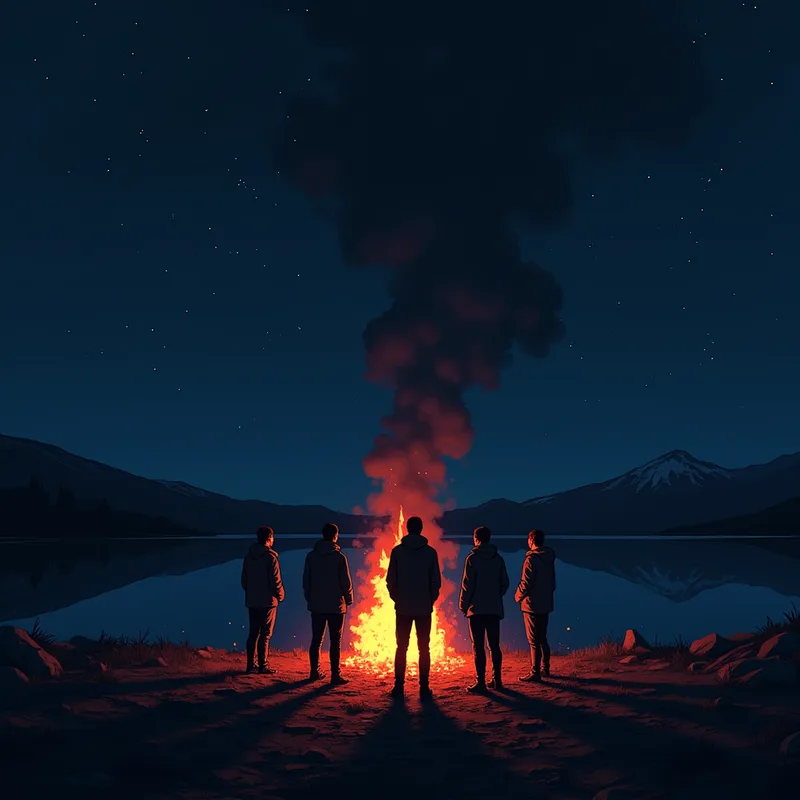
I will keep the order of the days, because the record is owed the order: the ninth night was the night the dark kept for the watch, and the tenth day was the day the lamp went out, and the two were the ones the coast owed the camp. The camp did not leave, and the not-leaving was the one the camp owed the fire: the fire was in the center, and the fire was the one thing that was ours; the kept place was by the hearth, and the kept place was the one the camp owed the one who is not here; and the distance was around the lake, and the distance was the one the camp owed the sleep. The three were the camp's part in the world, and the camp did not owe the world the leaving, and the not-owing was the one the camp kept for the fire.
I will not say that the choice was hard, because the not-saying is the one the record owes the choice: the choice of this camp was not the choice of the old world. In the old world, the archmage's choice was the thing the world owed the sanctum — the world put the choice in the archmage's hands, and the hands did the choosing, and the choosing was the archmage's part in the world. The choice of this camp was the thing the camp owed the world: the camp put the choice in its own hands, and the hands are the six of us, and the six are the one the camp owes the world. I will say that in the plain voice, because the record is owed the plain: the choice of the tenth day was not hard, and the not-hard was the one the camp owed the record. The camp had kept the four keepings since the first night on the broken coast — the distance, the sending, the fire, and the kept place — and the four keepings were the camp's part in the world, and the world did not owe the camp the asking about the four.
The question of the tenth day was the one the world did not ask.
I will keep the question in the record, because the record is owed the question: the question was the one the camp asked itself, and the self was the one the camp owed the question. The question was: does the camp owe the world the leaving? The world does not answer the question, because the world is not a thing that answers, and the not-answering is the one the world did not let go of. The question was the one the camp owed the world, and the world owed the camp the question, and the two owed each other the whole of the tenth day, and the tenth day was the one the camp owed the fire.
Rumzuck spoke first, and the first was the one the ogre owed the camp.
He said it the way the ogre says it — with his hands folded over the grip, and the folded was the ogre's part in the saying. He did not say much, and the not-saying-much was the one the ogre owed the camp: the ogre does not say much at the fire, and the not-saying-much was the whole of the ogre's part in the old world. He said: We stay. He said it the way the ogre says the thing — once, and the once was the whole of the saying, and the once was the one the ogre owed the camp. The ogre had walked since the third morning, and the walking was the one the ogre owed the crossing; the ogre had carried the firewood since the first day, and the carrying was the one the ogre owed the fire; and the ogre had kept the watch on the ninth night, and the keeping was the one the ogre owed the dark. The ogre had given the camp everything the ogre owed it, and the everything was the one the ogre owed the camp. We stay, he said, and the staying was the one the ogre owed the world.
Smackage said it the way Smackage says it — with his palm flat on the sand by the wall, and the flat was the ground's part in the saying.
He said: The ground is ours. The ground was the one the camp owed the world, and the world owed the ground the keeping, and the keeping was the one the camp had done since the first day on the broken coast. The camp had kept the ground the way the camp keeps everything on this world — without looking up, and the without-looking-up was the camp's part in the ground. The ground had not answered the camp, and the not-answering was the one the ground owed the camp; but the ground had kept the camp, and the keeping was the one the ground owed the fire, and the fire owed the ground the staying. The ground is ours, Smackage said, and the ours was the one the ground owed the camp, and the camp owed the ground the keeping.
Wreckreate did not say much, and the not-saying-much was the one the water-reader owed the camp.
The water-reader had read the current on the third morning, and the current had said east, and the east was the one the bones owed the camp. The water-reader had read the lake on the fifteenth afternoon, and the lake had said the sleep, and the sleep was the one the water owed the camp. And the water-reader had read the ninth night, and the ninth night had said the not-coming-back, and the not-coming-back was the one the dark owed the camp. The water-reader had read the world the way the water-reader reads the world — in the water, and the water was the one the world owed the reading; in the dark, and the dark was the one the world owed the reading; in the fire, and the fire was the one the world owed the reading. The water-reader said: The water does not say leave. The water had not said leave, and the not-saying-leave was the one the water owed the camp. The water had said the east, and the east was the one the bones owed the camp; the water had said the sleep, and the sleep was the one the water owed the camp; and the water had said the not-coming-back, and the not-coming-back was the one the dark kept for the reading. The water had said everything the water owed the camp, and the everything was the one the water owed the reading. The water does not say leave, Wreckreate said, and the not-leaving was the one the water owed the fire.
Zahlia said nothing, and the not-saying was the one the Veil owed the camp.
The Veil reads what the Veil reads, and the reading was the Veil's part in the camp. Zahlia had kept the not-true in the air since the night of the lie, and the keeping was the Veil's part in the not-true; the not-true was the one the Veil owed the saying, and the saying was the one the archmage owed the camp. The Veil had read the thirteenth day, and the thirteenth day had said the hall of seals, and the hall of seals was the one the gods owed the camp. The Veil had read the ninth night, and the ninth night had said the not-answering, and the not-answering was the one the dark owed the camp. Zahlia kept her hands in her lap, and the in-her-lap was the Veil's part in the tenth day. The Veil owed the camp the keeping, and the keeping was the one the Veil had kept since the first day on the broken coast. The Veil did not say the camp stayed, and the not-saying was the one the Veil owed the fire — the Veil says the thing when the thing is owed, and the thing was not owed until the fire said it.
I said it.
I will keep the saying in the record, because the record is owed the saying: the archmage says the thing the camp is owed, and the owed was the one the camp owed the fire. I said it at the fire, with the five of us around it, and the five-of-us was the one the camp owed the night. I did not raise my voice, and the not-raising was the archmage's part in the saying: the archmage does not sell a thing he says at the fire. I said: We stay. The fire is ours. The ground is ours. The water does not say leave, and the ground does not say leave, and the dark does not say leave, and the gods do not say leave, and the world does not say leave. The world is not owed the leaving. The world is not owed the camp, and the camp is not owed the world the leaving. We stay where the fire is, and the staying is the one the camp owes the fire, and the fire owes the camp the staying. I said it the way the archmage says the thing — plain, and once, and the once was the whole of the saying's part in the camp.
The fire took it the way the fire takes everything that is given to it.
The fire did not answer, and the not-answering was the one the fire owed the saying. The fire took it, and the taking was the fire's part in the tenth day: the fire burned the saying the way the fire burns everything — without looking up, and the without-looking-up was the fire's part in the world. The saying went into the fire, and the going-in was the one the saying owed the camp, and the camp owed the saying the keeping, and the keeping was the one the fire owed the saying, and the fire owed the keeping to the camp, and the camp owed the keeping to the world, and the world owed the keeping to the kept place, and the kept place owed the keeping to the one who is not here. The five keepings were the whole of the tenth day, and the tenth day was the one the camp owed the fire, and the fire owed the tenth day to the camp.
That was the choice, and the choice was the one the camp owed the world.
I will keep the choice in the record, because the record is owed the choice: the choice of the tenth day was the one the camp made for itself, and the for-itself was the whole of the choice's part in the camp. The camp did not owe the world the asking, and the not-owing was the one the camp kept for the choice. The camp had kept the four keepings since the first night on the broken coast — the distance, the sending, the fire, and the kept place — and the fifth keeping went into the fire on the tenth day, and the going-in was the one the camp owed the fire. The five keepings were the camp's part in the world, and the world did not owe the camp the answering about the five, and the not-owing was the one the world kept for the camp. The camp owed the world the staying, and the world owed the camp the staying, and the two stayings were the whole of the tenth day, and the tenth day was the one the story has kept since the first page of it.