
Act V — First Fire
Page 34 — The Night the Light Did Not Come Back
One of the watch did not come back to the fire.
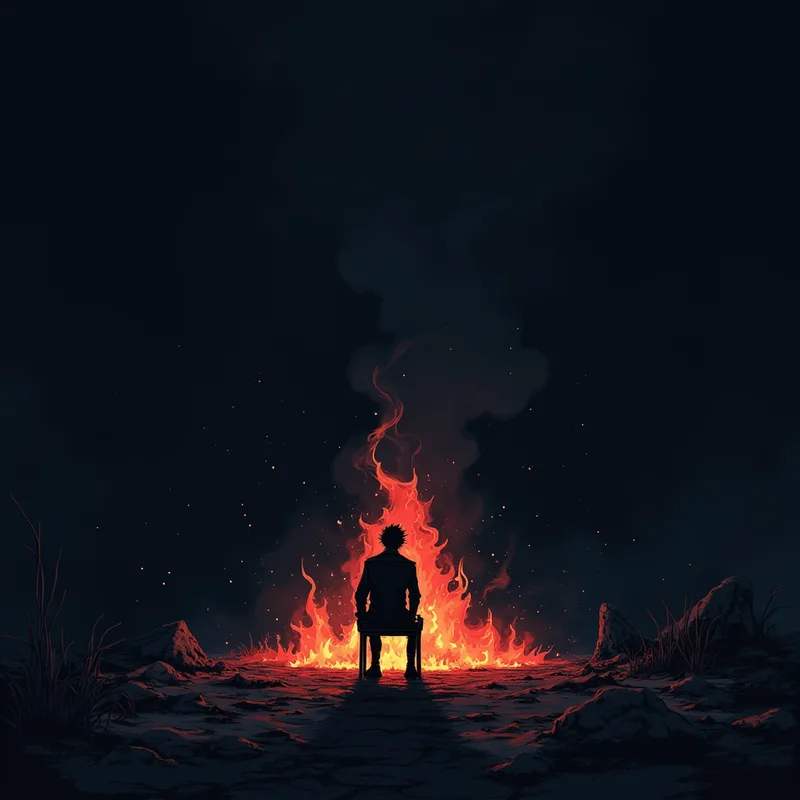
I will keep the order of the night, because the record is owed the order, and this night is the kind of thing the record can keep — a night, and not a saying. The lie had been in the fire since the night after the keeping began, and the camp had kept the distance, the sending, the fire, and the kept place, and the four keepings were the camp's part in the world. On the ninth night the world did the thing the world does on this coast — without looking up — and one of the watch did not come back to the fire, and the not-coming-back was the one the dark did not explain.
It was the ninth night, and the watch had been kept since the first night on the broken coast. The old world taught it the way the old world taught everything — two at a time, four hours, the fire low enough that the dark can see it but not the other way around. The low was the fire's part in the watch: the fire at the watch's low is the fire the dark reads, and the dark did not owe the fire the answering. I have kept the watch at the low a hundred times in a hundred camps, and the hundred was the archmage's part in the old world; the low had kept the camp in the old world, and the low owed the camp the dark's not-seeing.
That evening the watch was Wreckreate, and a woman from the tower up the beach — Serevane, the Shore-Keeper.
She had come down to the fire every evening since the second day, and the coming-down was the Shore-Keeper's part in the camp. The tower up the beach had the lamp, and the lamp was the one the tower owed the coast; the keeping of the lamp was the work of the tower, and Serevane had kept it for longer than the coast had been a coast. The tower's light had gone out on the second day, and the going out was the one the coast kept, and the camp did not ask about it, and the not-asking was the camp's part in the tower. But Serevane came down, and the camp gave her the place by the fire, and the place was the one the fire gave her the way the fire gives everything — without the courtesy of the asking.
She kept the count of the tides the old way — the marks on the tower's wall, the low tide and the high tide, the count against the marks, the against the one the count owed the wall. The new world had not changed the tides: the tides of the new world were the tides of the coast, and the coast kept the count the way it keeps everything on this world — without looking up. The old way was the one thing the new world had not taken from the coast.
You are not from here, she had said, on the second day, and it was not a question.
She said it to me, with her hands on the count, and the to-me was the one the saying owed the camp: the camp was the thing not from here, and the crossing owed the camp the not-from-here. Serevane does not ask the coast a question — the coast says the thing, and the saying is the one the coast owed the camp, and the camp owed the coast the hearing.
The coast says so. The coast says a lot of things.
The coast says the tides, and the tides are the one the coast owes the water; the coast says the current, and the current is the one the coast owes the east; the coast says the lamp, and the lamp is the one the coast owes the tower; and the coast says the camp, and the camp is the one the coast owes the crossing. The camp kept the saying the way the camp keeps the thing the coast says.
The lantern went out with the watch.
Wreckreate with the lantern, Serevane with her count. The two of them went out the way the watch goes out — the way the old world taught it, at the edge of the camp, where the ground of the camp met the ground of the coast, and the meeting was the one the coast owed the camp. The fire stayed at the low in the center; the dark had the watch; the lantern was in the dark, and the in-the-dark was the one the lantern owed the watch. The four hours went.
Wreckreate came back at the end of the four hours, with his face, and Serevane did not come back.
I have known the face since the old world — the face of the man who has been reading a letter he does not like. He had worn it at the water on the third morning, when the current said east; he had worn it at the lake on the fifteenth afternoon, when the sleep said the same. And he wore it at the fire on the ninth night. He did not say what he had read, and the not-saying was the water-reader's part in the coming back: the reading of the ninth night was not the reading he owed the camp. He sat down by the fire and kept his face the way the water-reader keeps everything, and the keeping was the one the dark did not explain.
The not-coming-back was the one the dark did not explain.
I looked at the dark. The archmage looks at the dark the way the archmage looks at everything — the craft under my ribs, and the craft is the one I owed the night. The craft can read a dark the way the craft reads a water: it finds the shape in it, and the shape is the one the dark owes the reading. The dark owed the craft nothing, and the craft found the shape of nothing, and the nothing was the one the dark owed the reading, and the reading owed the camp the not-finding. The dark did not answer. The dark is not a god — the gods are here, and the gods are not answering, and the not-answering was the whole of the thirteenth day, and the gods owed the camp the hall of seals. But the dark is not a god, and the dark does not owe the camp the answering, and the not-owing was the one the dark kept for the night. The silence it gave me was the same silence the hall of seals had given me. The silence of the hall of seals was the silence the old world gave me when the gods had finished with me; the silence of the dark on the ninth night was the silence the new world gave me when one of the watch did not come back. The two silences were the same, and the same was the whole of the world.
We did not go looking that night.
The finding is the one the camp owes the lost, and the lost was the one down the coast — but the looking for the not-coming-back was not the finding. We were learning, in one night, what a world that is not answered is: a world that is not owed. The camp had learned the world in the ground, in the weather, in the sky; the ninth night was the world's part in the learning, and the learning was the camp's part in the ninth night.
The tower's lamp went out the next morning, and the going out was the one the coast kept, and the coast did not explain it.
The sun came up on the tenth day the way the sun comes up on the broken coast — flat, no wind, the water still where the water goes. The camp woke the way the camp wakes: the fire was lit, the count was kept — the count without Serevane, and the without was the shape of the not-coming-back, and the shape was the one the morning kept for the camp. The tower up the beach had no light in it. The tower stood where the tower goes. The coast is not a thing that explains, and the not-explaining is the one the world does not let go of. The camp kept the count the way the camp keeps the thing it is owed, and the morning owed the camp the not-explaining.
I will not say what I thought, on that night, about the lie I had told the night before.
The lie had said the thread, the east, the patient. And on the ninth night the dark had kept the watch that the lie had sent out — the thread had been east, and the east was the one the dark kept for the thread; the thread had been moving, and the moving was the one the dark kept for the thread; and the moving had not come back to the fire, and the not-coming-back was the one the dark kept for the thread. The thought is the one the careful does not cover, and the not-covering is the one the page owed the record. I will say only this: the fire did not answer, the dark did not answer, and the not-answering was the first answer the new world gave me, and the answer is the one I have kept since the ninth night — kept for the kept place, and the kept place has kept it for the one who is not here, and the two keepings are the whole of the night.