
Act V — First Fire
Page 36 — The Founding of The Forgotten, the First Fire
The camp became a guild, on the morning of the fortieth day, because the forty days had done the becoming, and the saying of it was only the part that had to be spoken.
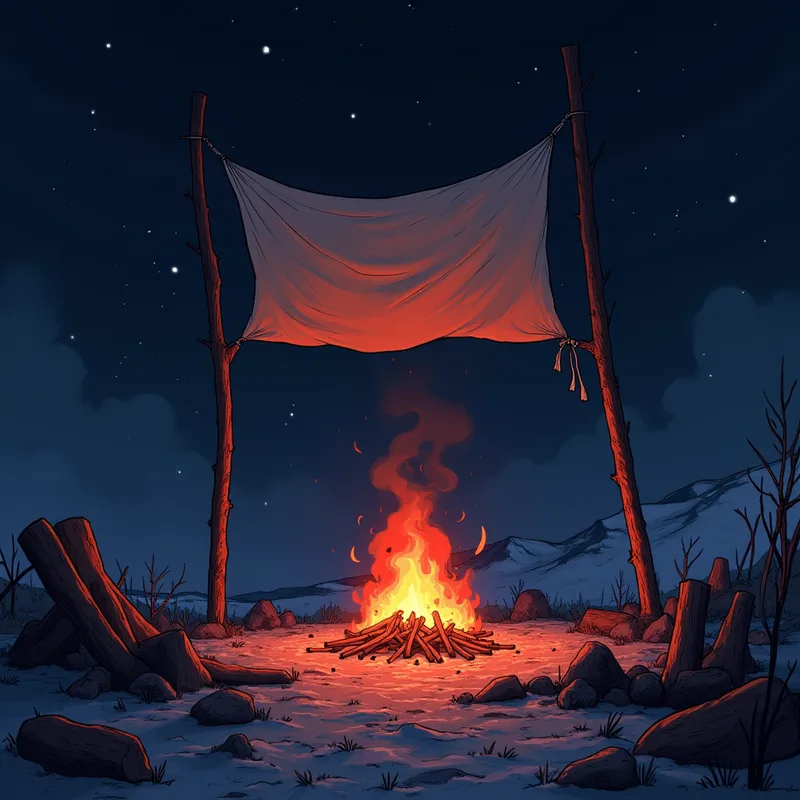
I will tell you the way it was done, because the way is the one the story keeps: we did not make a banner, and we did not cut a sign, and we did not write a law on the rock. A banner is a claim, and a claim is a door, and the door was the one the world did not owe us yet. A sign is a mark, and a mark is a thing the world can take, and the taking was the one we did not give it. A law on the rock is a law the world can weather, and the weathering is the one the world does not let go of. The old world would have done all three of them, and the doing was the old world's part in the guild: the guilds of the old world had banners and signs and laws on the rock, and the three were the ones the old world owed the guilds, and the guilds owed the three the keeping. We did the one thing the old world would not have done: we kept the fire. The camp's fire had burned since the eleventh page of this story, and the keeping of it was the whole of the founding — the fire that the found will come back to, the fire that does not go out because the going out would be the end of the finding, and the finding is the one that does not end.
The Forgotten was named before it was founded.
I will keep the before in the record, because the record is owed the before: the name had come from Wreckreate, on the fourteenth morning, and the morning was the one the water owed the name. I want to say the saying of the name in the record, because the record is owed the saying: Wreckreate said it at the water's edge, on the morning after the answer, with his hands in the water, and the in-the-water was the water-reader's part in the saying. He said: The world has forgotten us. We are the forgotten. Let us be the forgotten of the camp — the ones the world does not owe, and the camp keeps for itself. He said it the way the water-reader says the thing he has read — plain, and once, and the once was the whole of the saying. The camp kept the name the way the camp keeps the thing it is owed, and the keeping was the camp's part in the name. The forty days had been the forty days the name had needed to become true, and the forty were the one the camp owed the becoming: the camp had kept the distance, the sending, the fire, the kept place, and the staying, and the five keepings were the camp's part in the world, and the name had sat over the five keepings the way the name sits over the thing it names — without touching it, and the not-touching was the whole of the forty days.
I have the practice of the difference — the difference between a name that is given and a name that is become, and the difference is the one the record keeps.
A name that is given is a thing you owe, and the owing is the one the name owes the bearer: the given name sits on the bearer the way the given name sits on everything the world has given it, and the sitting was the one the old world owed the name. A name that is become is a thing you are, and the being is the one the name owes the bearer, and the being is the one the new world owed the camp. The given name can be taken back by the world that gave it, because the taking was the one the world owed the given; the become name cannot be taken, because the becoming was the one the camp owed itself, and the self is the one the world does not have. I have kept the difference since the old world, and the keeping was the archmage's part in the old world: the sanctums of the old world had been given their names by the gods, and the given was the one the gods owed the sanctums; and the given names went when the gods went, and the going was the one the old world owed the gods, and the gods owed the going to the old world. The become name is the one thing the new world owed the camp that the old world never gave it, and the owing was the whole of the difference.
When I said it, at the fire, on the morning of the fortieth day, the five of us were around it, and the five-of-us was the one the camp owed the morning.
I said it the way the archmage says the thing he owes — plain, and once. I said: The camp is The Forgotten. The name is the one Wreckreate gave it, on the fourteenth morning, and the giving was the water's part in the camp. The fire is the one the camp keeps. The distance is the one the camp keeps. The kept place is the one the camp keeps. The finding is the one the camp keeps. The camp does not owe the world the banner, the sign, or the law on the rock. The camp owes itself the fire, and the fire owes the camp the staying. I said it once, and the once was the whole of the saying's part in the camp. The five of us kept the saying the way the camp keeps the thing it is owed, and the keeping was the camp's part in the morning.
Rumzuck put his hand on the fire.
I will keep the putting in the record, because the record is owed the putting: the ogre's hand went over the flame, and the over-the-flame was the ogre's part in the morning. The hand did not touch the fire, and the not-touching was the one the ogre owed the fire: the ogre has walked since the third morning, and the walking was the one the ogre owed the crossing; the ogre has carried the firewood since the first day, and the carrying was the one the ogre owed the fire; and the ogre has kept the watch since the first night, and the keeping was the one the ogre owed the dark. The ogre had given the camp everything the ogre owed it, and the everything was the one the ogre owed the camp. He said: Then the fire is the guild. The saying was the ogre's part in the morning, and the morning owed the saying to the guild, and the guild owed the saying to the camp, and the camp owed the saying to the world, and the world owed the saying to the kept place, and the kept place owed the saying to the one who is not here. The five owedings were the whole of the morning, and the morning was the one the guild owed the camp.
We did not write the law on the rock, and the not-writing was the one the guild owed the world.
The first law was already in the camp — the no-leaving, and the no-leaving was the one the camp owed the fire since the tenth day. The second law was the distance, and the distance was the one the camp owed the lake. The third law was the kept place, and the kept place was the one the camp owed the one who is not here. The laws of the guild were the laws the camp had kept since the first night on the broken coast, and the keeping was the camp's part in the laws. The guild did not need the rock, because the rock is the thing the world can weather, and the weathering was the one the world owed the rock. The guild's rock was the fire, and the fire is the one thing the world cannot weather, and the not-weathering was the whole of the guild's part in the world.
On the morning of the fortieth day, the camp became a guild, and the becoming was the one the forty days owed the camp.
I will keep the becoming in the record, because the record is owed the becoming: the becoming was not a thing the world gave the camp, and the not-giving was the one the world owed the camp. The becoming was a thing the camp did to itself, and the to-itself was the whole of the becoming's part in the guild. The camp had become the guild the way the name had become the camp — over the forty days, and the forty were the one the camp owed the becoming. The fire burned in the center, and the burning was the one the fire owed the guild; the walls stood where the walls went, and the standing was the one the walls owed the camp; the kept place sat empty by the hearth, back from the light, and the empty was the one the kept place owed the morning. The guild owed the world the staying, and the world owed the guild the not-taking, and the two were the whole of the fortieth day, and the fortieth day was the one the camp owed the guild.
That is the founding, and the founding is the one the story keeps.
I will say the keeping in the plain voice, because the record is owed the plain: the guild was founded on the morning of the fortieth day, on the broken coast, in the wrong world, with the five of us and the one empty seat. The guild's banner is the fire, and the fire is the one the guild does not owe the world. The guild's sign is the keeping, and the keeping is the one the guild does not owe the world. The guild's law is the fire, and the fire is the one the world does not weather. The guild is the one the camp became, and the becoming is the one the forty days owed the camp, and the camp owes the becoming to the guild, and the guild owes the becoming to the kept place, and the kept place owes the becoming to the one who is not here, and the three owings are the whole of the founding, and the founding is the one the story has kept since the first page of it.