
Act V — First Fire
Page 30 — The Warning
Some doors are closed for a reason.
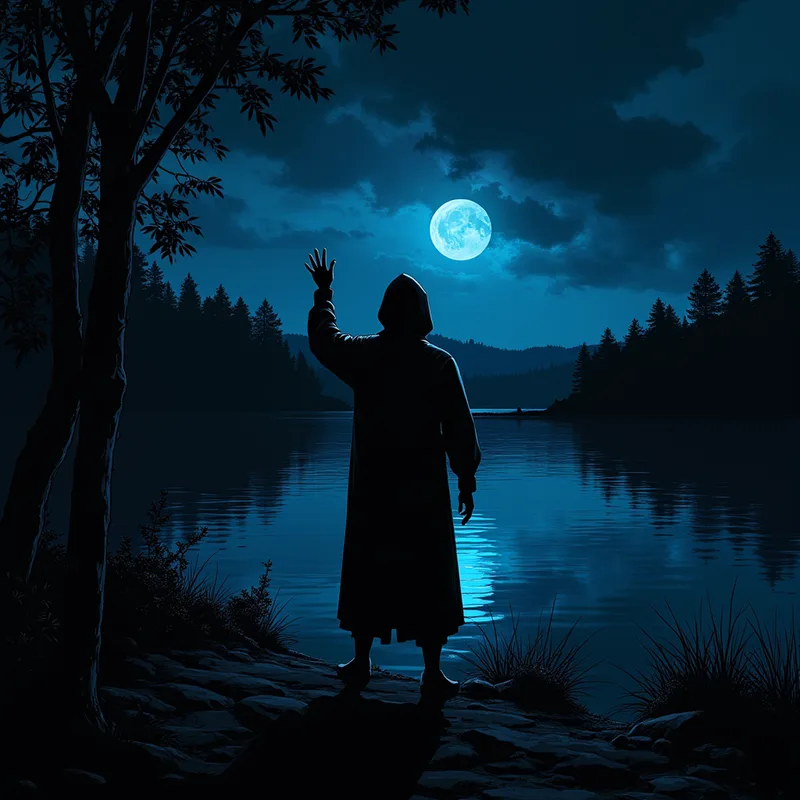
I will keep the order of the sixteenth morning in the record, because the record is owed the order: the camp had slept at the camp, and the lake was east, and the two were-where was the whole of the between's part in the camp. The camp had kept its ground in the tundra, and the ground was the one the camp owed the between, and the between was the one the ground gave us. The sixteenth morning was the morning the camp owed the saying, and the saying was the one the water-reader owed the camp.
The camp stood at the water's line on the sixteenth morning.
I will keep the standing in the record, because the record is owed the standing: Wreckreate stood at the line with his hands at his sides, and the at-his-sides was the water-reader's part in the morning; the rest of us stood behind him, and the behind was the camp's part in the morning — Rumzuck with the grip under his arm, Smackage with his palm flat on the tundra, Zahlia a little back from the water with her hands in her lap, and me where the craft's part of the camp is. The five of us took the standing the way the camp takes the thing that is owed it, and the taking was the camp's part in the sixteenth. The lake was where the lake goes, flat and silver, and the flat was the one the water kept for the morning, and the silver was the one the light kept for the water, and the two keepings were the lake's part in the camp.
Wreckreate said it plainly, at the water's edge, and the camp heard it, and the camp will remember it, because the remembering is the one that is owed.
The water-reader says a warning the way he says everything — with the argument already finished, and the finished was the water-reader's part in the saying. The saying was at the water's edge, and the at-the-edge was the saying's part in the morning. I will keep the three of the saying in the record, because the record is owed the three, and the three were the whole of the warning's part in the camp.
The lake is not a door.
The not-door was the first of the three, and the first was the one the warning owed the camp. I will keep the not-door in the record, because the record is owed the not-door: the camp had stood at the edge of the lake on the fifteenth afternoon, and the camp had looked at the lake and seen the door in it — the craft under my ribs had found the shape under the silver, and the shape was the door's part in the water. The water-reader had said the shape was the sleep, and the sleep was the one the water owed the lake, and the lake was not the door that opens onto the sleep. The door opens both ways — the camp walks into the door, and the other side walks into the camp — and the two walkings were the door's part in the old world. The lake does not open, and the not-opening was the lake's part in the not-door.
The lake is a lid.
The lid was the second of the three, and the second was the one the warning owed the camp. I will keep the lid in the record, because the record is owed the lid: Smackage reads the ground, and the ground is the one the camp owes the tundra, and the tundra is the one the ground owes the lid — the lid under everything, the lid under the coast, the lid under the tundra, and the lid under the lake, and the four lid-parts were the ground's part in the new world. The lid under the lake was the lid that had been put down, and the put-down was the whole of the lid's part in the lake. A lid is the thing the world puts down when it is done with a room, and the done-with-the-room was the world's part in the lid: the world has the room under the lake, and the room is the one the world keeps for the sleep, and the sleep is the one the world keeps for the room, and the three keepings were the whole of the lid's part in the new world. The lid was the second of the three, and the second was the one the lid owed the morning.
And a lid is the thing the world puts down when it is done with a room.
I will keep the saying of the lid in the record, because the record is owed the saying: the water-reader said the lid the way the ground-reader says the ground — not as a thing the lake is, but as a thing the world does to the lake, and the doing was the world's part in the lid. The world here is a wall that reads back, and the reading-back was the Veil's part in the world — Zahlia felt it on the sixteenth page, and the feeling was the Veil's part in the world. The lid under the lake was the world's part in the not-looking-up, and the not-looking-up was the one the camp could not read off. The lid was the thing the world had put down, and the put-down was the lid's part in the morning.
We do not go in.
I will keep the three nots in the record, because the record is owed the three nots. The first not was the camp's part in the warning: we do not go in, and the not-going-in was the camp's part in the lake. The camp had stood at the edge of it on the fifteenth afternoon, and the standing was the camp's part in the not-going-in — Wreckreate's hand had been out over the silver, and the over-the-silver was the reading's part in the not, and the camp had kept its ground when the reading was done, and the keeping was the camp's part in the not. The not-going-in was the whole of the camp's part in the first not, and the not was the one the warning owed the camp.
We do not send into it.
The second not was the camp's part in the sending: the sending east had been made three times by the sixteenth morning — the fourth day, the ninth, and the fourteenth — and the sending had gone by the water, and the by-the-water was the way the camp had kept the water between the going and the coast. The sending had gone around the lake, and the around was the sending's part in the lake: the water-reader had said the lake is not a door, and the not-door was the one the sending owed the lake. The second not was the sending's part in the warning, and the not-sending was the one the camp owed the lake, and the lake owed the camp the between.
We do not read it past the reading we have done.
The third not was the craft's part in the warning, and the craft was the one I had kept under my ribs since the white. I will keep the third not in the record, because the record is owed the third not: the craft under my ribs had found the suggestion on the fifteenth afternoon, and the suggestion was the only part of it the craft would give me, and the only-part was the craft's part in the not-past. The craft can read a water the way the craft reads a water — it finds the shape in it, and the shape is the one the water owes the reading, and the water does not owe the reading the sleep under the lid. The reading past the reading was the craft's part in the not, and the not was the one the warning owed the craft. I held the shape of the third not under my ribs, and the holding was the archmage's part in the warning.
Because a reading is a thing you do to a sleeping thing, and the sleeping thing was not owed us.
I will keep the because in the record, because the record is owed the because. The because was the water-reader's part in the third not, and the part was the one the warning owed the camp: the reading is the thing the camp does to the water, and the water is the thing the camp does not owe the sleep, and the not-owing was the whole of the because's part in the warning. The sleeping thing was not owed the camp, and the not-owed was the one the world owed no one — the world is not owed the six of us a welcome, and the not-owed is the one we were not ready to name on the ninth day, and the ninth day was the day the camp owed the not-owed. The reading of the sleeping thing was the camp's part in the not-owed, and the not-owed was the one the warning owed the camp, and the camp owed the warning the not-reading.
He said it at the end, the thing that was the whole of the warning.
Some doors are closed for a reason, and the reason is not ours to open.
I will keep the last saying in the record, because the record is owed the last saying. The water-reader said it the way he says everything — with the argument already finished, and the finished was the water-reader's part in the last saying. The last saying was the whole of the warning: the door is the thing the two sides owe each other, and the door that is closed is the door the two sides did not owe each other, and the not-owing was the closed's part in the door. The reason is not ours to open, and the not-ours was the camp's part in the warning: the camp has the finding, and the finding is the one the camp owes the lost, and the lost is not the sleep under the lid. The reason belongs to the one who closed the door, and the closed was the world's part in the door, and the world is not here to be owed the opening.
The camp heard it.
I will keep the hearing in the record, because the record is owed the hearing. The five of us took the warning the way the camp takes the thing that is the law: Rumzuck's hands went back over the grip, and the going-back was the ogre's part in the hearing; Smackage put his palm flat on the tundra, and the flat was the ground's part in the hearing — the ground holds the lid, and the holding was the ground's part in the not-opening; Zahlia's hands were in her lap, and the in-the-lap was the Veil's part in the not-reading; and the craft under my ribs went quiet, and the going-quiet was the archmage's part in the hearing, and the part was the one the camp owed the lake. The hearing was the one the world does not let go of — the world keeps the hearing the way the world keeps everything on this coast, without looking up, and the without-looking-up was the one the camp owed the warning, and the warning owed the camp the not-reading, and the not-reading was the whole of the sixteenth morning of the new world, and the morning was the one the camp kept for the lake, and the lake kept it for the sleep, and the sleep is the one the story has kept since the first page of it.