
Act IV — The Sleeping Water
Page 27 — The First Law
No one is beyond being found again.
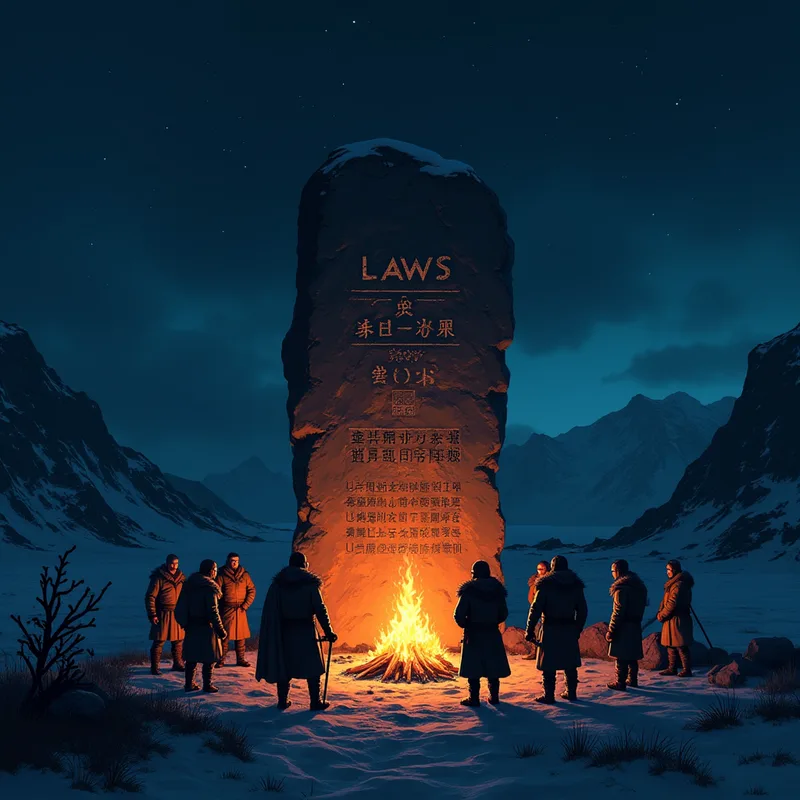
I said it at the hearth, in the plain voice, the way you say a thing that is going to be the whole of a life. I will say that in the plain voice, because the record is owed the order of it: the name had come from Wreckreate on the fourteenth morning, at the fire, and the law came from me on the fourteenth afternoon, at the same fire, and the morning-and-afternoon was the fourteenth day of the new world. The camp had a name by noon, and a law by the time the sun went down, and the two of them had gone into the ground the way the two of them go into the ground — without ceremony, without the courtesy of the asking, and the not-ceremony was the fourteenth day's part in the two.
The five of us were around the fire. I will keep the count in the record, because the count is the one the story keeps: Rumzuck at the front, with his hands folded over the grip, and the folded was the ogre's part in the afternoon; Smackage a little back, his palm flat on the sand by the wall, and the flat was the ground's part in the afternoon; Wreckreate where the water's corner met the fire, and the meeting was his; Zahlia with her hands in her lap, the air around her not going thin, and the not-going-thin was the Veil's part in the afternoon. And me at the fire, where the craft's part of the camp is, and the craft under my ribs was the one I had kept since the white.
The sixth place was by the hearth, set a little back from the light. There was no chair in it. I will say that in the plain voice, because the record is owed the no-chair: the camp had five seats by the fourteenth afternoon, and the five seats were the ones the five of us owed the ground. The sixth place had no seat, and the no-seat was the whole of the keeping — the keeping of the place for the one who is not here, and the not-here was the one the fourteenth day did not let go of. The giving of a chair would have been the end of the keeping, and the keeping is the whole of the guild, and I have not sat in the sixth place since the sixth day, and I will not. The giving of the chair was the thing the camp was not ready to owe the kept place, and the not-ready was the one I owed the record. The kept place stayed empty the way the kept place goes — back from the light, and the back-from-the-light was the one the story has kept since the sixth day.
The law is short.
I want the record to be careful about that, because the short is the whole of the law. It is one sentence, and the one-sentence was the law's part in the fourteenth afternoon. I have said longer things at the fires of the old world — the naming of a universe is a long work, and the work takes its length — but a law is not a naming, and the not-naming was the difference the fourteenth day taught me. A naming gives the thing its shape, and a law gives the thing its owing, and the owing is the part the naming does not have. I have kept the law at one sentence since the afternoon, and the keeping is the one that has not broken.
No one is beyond being found again.
I will say it a second time in the record, because the saying it is the one the law keeps for itself. And I will say what it is not, because the not is the one the record is owed. It is not a promise that the lost will come back — the camp does not promise that, and the not-promising was the law's part in the not. The camp promises the finding, and the finding is the one the camp owes. It is not a ward: Zahlia's wards keep the Veil from reading the camp, and the keeping was the Veil's part in the camp; a ward keeps a line, and the law keeps a debt, and the debt is the part the ward does not have. It is not a prayer: the gods are here, and the gods are not answering, and the not-answering was the whole of the thirteenth day; a prayer is owed an answer by the one who hears it, and the not-hearing was the thing the new world owed no one. The law is owed by us, to them, whether the world owes anything or not — the owed was the whole of the law, and the not-owed-of-the-world was the part the law did not depend on.
Not the lost, who are down the coast.
The lost is the one the law was made for first, and the first was the law's part in the camp. Six went through, and five are here, and the one not here is the one the law is about — down the coast, in the current, in the water or under it, wherever the water's reading puts him and the reading does not end. The camp says the law with the sending — two of us east, by the water, on the fourth day and the ninth and the fourteenth, and the sending was the law's part in the coast. It says it with the mark — the two lines, crossing, the one circle, the empty place in it, cut in the black rock at the water's edge, and the mark was the law's part in the stone. And it says it with the kept place — the sixth place by the hearth, back from the light, no chair, and the kept place was the law's part in the fire. The three sayings were the camp's part in the lost, and the camp has kept the three since the fourteenth day.
Not the forgotten, who are in the water or under it.
The forgotten is the second the law was made for. Wreckreate said the old world's part of it on the fourteenth morning — the old world forgets what it throws out, and the forgetting is the world's way of not owing — and the law was the camp's answer to the forgetting, and the answer was the one the camp owed the old world, and the old world was not there to be owed it. The forgotten are in the water or under it, and the in-the-water was the whole of the forgetting's part in the new world: the new world keeps its forgotten the way the new world keeps everything, without looking up, and the without-looking-up was the one the camp could not read off. The camp will look down the coast, by the water, on the fourth day and the ninth and the fourteenth, and the looking was the law's part in the water. The camp will look under it, with Smackage's palm on the sand, and the under was the ground's part in the looking. The three lookings were the camp's part in the second, and the camp has kept them since the fourteenth afternoon.
Not the ones the world throws out.
The ones the world throws out is the third the law was made for, and the third was the law's part in the not — the not of the world's owing, and the not-owing was the world's part in the throwing. The throwing out is not a thing that is owed a return, and the not-owing was the whole of the world's part in the throwing-out. But a finding is owed, by us, to them, whether the world owes anything or not. The ones the world throws out are not the camp's debt — the camp did not throw them out; the world did, and the world's throwing was the world's part in them. The finding is the camp's debt, and the debt was the one the camp took on at the hearth on the fourteenth afternoon, and the taking was the law's part in the camp. The camp that takes the debt says: we will find them. The saying was the one the camp owed them — the ones the world had not looked at, and the not-looking was the one the camp looked at instead.
Rumzuck said: Then we keep looking.
He said it with his hands folded over the grip, and the folded was the ogre's part in the law. He did not argue with the law, and the not-arguing was the ogre's part in the afternoon — Rumzuck does not argue with a line, and the line is the one he has kept since the first morning on the broken coast. The camp took the saying the way the camp takes the thing that is right, and the taking was the camp's part in the law. Smackage put his palm back on the sand, and the putting-back was the ground's part in the law — the ground holds the camp, and the ground holds the finding, and the two holdings were the ground's part in the afternoon. Wreckreate did not say anything to the law, and his nothing was the water-reader's part in it: the reading of the coast is the law's proof, and the proof is the one the water owes the camp. And Zahlia held the law in the air, a moment, after I said it — her hands a little raised, the air around her going thin, and the thin was the one that was not doubt. She kept the sentence the way she keeps a word, and the keeping was the Veil's part in the law, and the Veil kept it for the camp.
A camp that does not look for its lost is not a camp. That is the whole of the law, and I want the record to be careful that it is the whole of it: the finding is the same thing as the staying, because a camp that stops looking stops staying, and a camp that stops staying is a camp the world has finished with. The five of us took the law the way the five of us took the name — not by choosing it, but by being the kind of camp the law fits, and the being-the-kind was the fourteenth afternoon.
It was the first law of The Forgotten, and I have kept it, and the keeping is the one that has not ended.