
Act V — First Fire
Page 28 — They Find Hollowmere
A day's walk east, by the water, and the coast gave way to the lake.
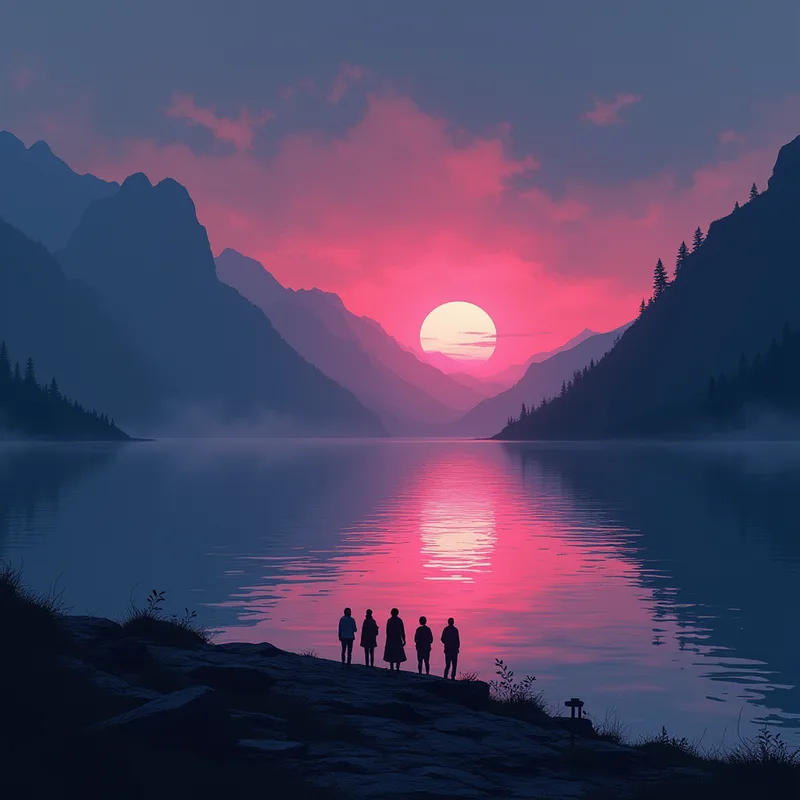
I will keep the order of the fourteenth day in the record, because the record is owed the order: the camp was at the camp, and the sending east had been made twice by then — the fourth day, two of us by the water, and the ninth, and the two sendings had come back with the current and the current's own silence. I said it at the fire, in the plain voice, the way you say a thing you have already decided: I am going down the coast. The sending was two of us. I will be one of the two, and I will go further than the sendings went, because the bones said east, and the bones do not repeat themselves. The camp took the saying the way the camp takes the thing that is the law, and the four of them and me the way the camp keeps its count since the third morning.
The third sending went down the coast on the fifteenth morning.
I will say that in the plain voice, because the record is owed the morning: the sun was up by the time the camp had the fire lit, and the fire was low, because the fire was owed the low — the low that the dark can see but the other side cannot, the low the old world taught the camp for the watch, and the watch's low was the whole of the fire's part in the going. I went by the water, with the water on my left, and the by-the-water was the way the camp had kept the water between the going and the coast since the fourth day. The water was flat that morning — flat in the way the coast's water was flat, the flat of the wrong world, and the flat was the one I had kept since the first morning. I walked it the way I walk a coast I have to find a thing on, and the walking was the archmage's part in the sending: not fast, not slow, and the not-fast was the one that kept the body for the day's work. The air was thin in the way the air goes thin when Zahlia holds a word, but the thin was not Zahlia's, and the not-Zahlia was the whole of the air's part in the morning.
I will not tell you how long the walk was.
I will tell you the ground, because the ground is the one the record can keep. The sand went out by the water's line the way the sand goes out — not all at once, but the way the ground gives way to the ground, and the giving was the coast's part in the morning. The black rock went in from the coast the way the black rock goes — the rock that the camp's walls were set of, the rock the seam-stone had cut, the rock the mark was in, and the three rock-parts were the coast's part in the going. The tundra came on the second part of the walk, and the coming was the ground's part in the morning: the ground that Smackage reads, the lid under everything, and the lid was the one the ground kept under the tundra the way the ground keeps the lid under the coast. I walked over the lid, and the walking-over was the archmage's part in it — the flat under, the under that did not end, and the not-ending was the ground's part in the tundra.
And then the coast gave way, and the giving was the one the morning owed the record.
The lake was Hollowmere. I will say the name in the record, because the name is the one the water-reader gave the lake on the reading after the finding, and the after was the whole of the naming's part in the lake: I found it with the sight, and the sight was the one the archmage owed the coast, and the coast owed the finding the lake.
I will tell you the lake the way the record is owed the lake.
The lake is a drowned place under a dark, still water. I will say drowned in the plain voice, because the word is the one the ground gave the lake — the ground of the lake's floor is the ground of a thing that was ground once, and the once-ground was the whole of the drowned's part in the lake. There are no shores the way the coast has shores, and the no-shores was the lake's part in the not-coast: the water came out of the ground the way the water comes out of the ground in the wrong world, without the courtesy of the bank, and the without-the-bank was the lake's part in the morning. The water was flat. I will say that twice, because the flat is the one the record is owed. Not calm — flat. The flat of a thing that has stopped being water and has not yet decided what to be instead. I have kept a watch on water that was calm, and I will not name the water; I have not kept a watch on water that was flat, and the not-kept was the whole of the lake's part in the morning.
The light on it was silver.
I will say the silver in the plain voice, because the record is owed the silver: the light came off the water the way the light comes off the water in the wrong world — flat, and the flat was the one the light kept for the lake. I looked for the source of it, and the looking was the archmage's part in the morning: the craft under my ribs can find the source of a light, and the finding-the-source was the work the craft owed the archmage, and the archmage owed it to the record. I looked at the sky, and the sky had no source in it — the sky of the wrong world, the old stars in the wrong places, and the wrong-places was the whole of the sky's part in the morning. I looked at the ground, and the ground had no reflection in it, and the no-reflection was the ground's part in the silver. I looked at the water, and the water had the silver in it, and the having-the-silver was the one the lake did not owe the source. The silver came from nowhere I could find, and the nowhere was the whole of the light's part in the morning.
There was no wind.
I will say that in the plain voice, because the record is owed the no-wind. I have kept a watch in winds I will not name — the winds of the old world's coast, the winds that the old world's camp had to read the way the camp read the ground — and I have not kept one in more stillness than that morning. The air over the lake was still in the way the air goes still when the Veil is thin, but the still was not the Veil's, and the not-Veil was the whole of the stillness's part in the morning. The water did not ripple, and the tundra did not move, and the two not-movings were the lake's part in the stillness. And the five of us came down the coast and stood at the edge of it, and the standing was the camp's part in the morning.
The camp came to the lake on the fifteenth afternoon.
I will keep the order of the camp in the record, because the record is owed the order: I was at the water's line by midday, and I went back the way I had gone — by the water, the tundra on my right, the lid under my feet, and the three parts were the going-back's part in the afternoon. I told the camp at the fire, in the plain voice, the way you say a thing you have found: There is a lake. A day's walk east, by the water. The coast gives way to it. The light on it is silver, and the silver has no source I can find. There is no wind. The camp took the saying the way the camp takes the thing that is the law — and the taking was the camp's part in the afternoon. We came to it on the fourteenth and the fifteenth — the fourteenth was the day the name came to the camp, and the fifteenth was the day the camp came to the lake, and the two days were the whole of the finding's part in the camp. The five of us came to it: Rumzuck in front, with the grip under his arm, and the under-the-arm was the ogre's part in the going; Smackage with his palm a little off the ground, the not-flat the ground-reader's part in the not-reading; Wreckreate at the water's edge; Zahlia a little back from the water, her hands in her lap; and me behind the five, where the craft's part of the camp is, and the behind was the one I had kept since the white.
Wreckreate walked to the edge, and he stopped, and the stopping was the whole of the afternoon.
I will keep the stopping in the record, because the record is owed the stopping: the water-reader does not walk to the water the way the camp walks to the water — he walks to it the way a man walks to a letter he has to read. He put his hand out — not in the water, out. I will say that in the plain voice, because the record is owed the not-in: the hand was over the water the way the hand goes over a thing you are not sure is ground, before you step off it, and the over-the-water was the whole of the hand's part in the stopping. The hand was flat, the way Wreckreate's hand goes flat when the reading is not done, and the flat was the water-reader's part in the not-reading. He held it there, over the silver: the reading of the lake had already begun before the hand went out, and the before was the water-reader's part in the stopping — the reading finished before the telling, the way the water-reader finishes everything before the rest of the camp catches up.
He said, very quietly, the only thing that was left to say.
We do not go in.
I will keep the saying in the record, because the record is owed the saying: the water-reader does not say a thing quietly because the thing is small — he says it quietly because the thing is the whole of the morning, and the whole-of-the-morning was the water-reader's part in the quiet. The five of us took the saying the way the camp takes the thing that is the law. Rumzuck's hands went back over the grip, and the going-back was the ogre's part in the not-going-in. Smackage put his palm flat on the tundra, and the flat was the ground's part in the not-reading. Zahlia's hands were in her lap, and the in-the-lap was the Veil's part in the not-holding. And the craft under my ribs did the thing the craft does when the camp keeps its ground — it went quiet, and the going-quiet was the archmage's part in the afternoon, and the part was the one the camp owed the lake. We stood at the edge of the lake on the fifteenth afternoon, and the standing was the camp's part in the morning, and the lake was east, and the between was the one the ground gave us, and the ground's giving was the first gift the new world gave the camp that it did not spend.