
Act IV — The Sleeping Water
Page 26 — The Name They Give Themselves
The Forgotten.
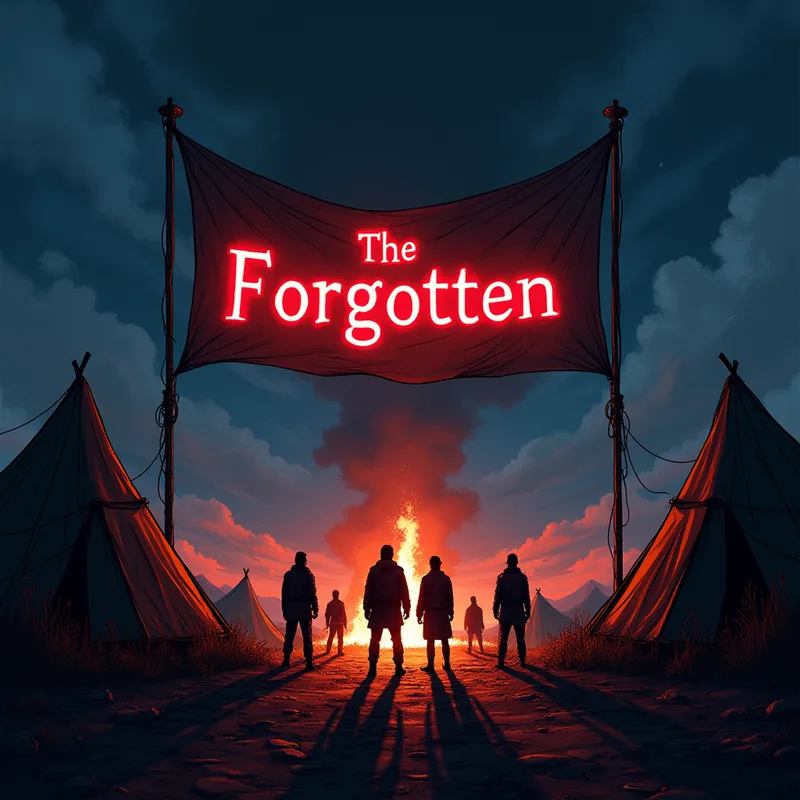
The name came from Wreckreate, at the fire, on the fourteenth morning, and I will tell you the reason, because the reason is the one the story keeps. I will say that in the plain voice, because the record is owed the order of it: the name was not the camp's part in the fourteenth morning at first. The fourteenth morning was the morning the camp had — the fire in the center, the walls where the walls go, the corners where the corners go, the kept place where the kept place goes. The fourteenth was the third sending, and the third sending went down the coast the way the fourth and the ninth had gone — two of us east, by the water, and the by-the-water was the way the camp kept the water between the going and the water's own part. The two came back with the current and the current's own silence, and the silence was the finding's part in the morning, and the part was the one the water did not let go of.
The name came at the fire, after the third sending was back, and the after was the whole of the fourteenth morning's part in the name.
The camp was where the camp goes on the fourteenth morning: Rumzuck at the front of the door with his hands folded over the grip, the folded was the ogre's part in the morning; Smackage on the ground where the ground's part of the camp is, his palm on the sand, the flat was the ground's part in the morning; Zahlia a little back from the fire, her hands in her lap, the air around her thin the way the air went thin on the sixteenth page, and the thinning was the Veil's part in the morning; and me at the fire, where the craft's part of the camp is. Wreckreate was at the corner by the water, because the water's part of the camp was his, and the part was the one the camp had given him on the sixth day, and the giving was the whole of the corner's part in the camp. He came to the fire for the name, and the coming was his part in the fourteenth morning — the water-reader leaving the water's line to say the thing the water did not say, and the thing was the name, and the name was the one the camp owed the fourteenth day.
I will tell you the reason.
The reason was the whole of the name's part in the morning, and I will say it the way Wreckreate said it, because the saying was his, and the his was the part the camp did not take from him. He stood at the fire the way the water-reader stands when the water has given him the thing that has to be spoken — with his hands at his sides, and the at-his-sides was the water-reader's part in the standing. His face was not the face of a man who has been reading a letter he does not like. I will say that in the plain voice, because the record is owed the not-face: his face was the face the water-reader has when the reading is done and the telling is the only part of it left — the face of the reading finished, and the finished was the whole of his face's part in the morning.
The old world threw us out, he said.
The saying was the first of the reason, and the first was the one the reason owed the camp. The old world threw us out — the throwing-out was the white's part in the old world, and the part was the one the white did not let go of through the six of us. The six of us went through, and the going-through was the one the white kept for the six, and the six were the old world's part in the throwing-out. The old world did the throwing-out the way the old world does everything — without looking up, and the without-looking-up was the old world's part in the throwing-out.
The old world has a word for what it does with things it throws out — it forgets them.
The word was the second of the reason, and the second was the one the reason owed the camp. Forgets them — the forgetting was the old world's part in the throwing-out, and the part was the whole of the old world's part in the word. I have known the old world's forgetting, and the knowing was the archmage's part in the old world: the forgetting is not a hate, and the not-hate was the old world's part in the forgetting. The old world's camp that is thrown out is a camp the old world does not hate, and the not-hating was the whole of the old world's part in the camp: the old world does not keep the camp, and the not-keeping was the old world's part in the forgetting, and the not-keeping was the whole of the old world's part in the word. It forgets them, and the forgetting was the world's way of not owing — the not-owing was the old world's part in the forgetting, and the part was the whole of the word's part in the reason.
We are the Forgotten.
The saying was the third of the reason, and the third was the one the reason owed the camp. The name went out over the fire the way the name goes — plain, and once, and the once was the name's part in the morning. The five of us took it the way the five of us take the thing that is right, and the taking was the camp's part in the name. I will say that in the plain voice, because the record is owed the not-choosing: the name was not chosen by the camp, and the not-choosing was the name's part in the fourteenth morning. The camp did not choose the name, and the not-choosing was the one the name did not let go of — the name came to the camp the way the right thing comes, and the coming was the part the camp did not make.
And the Forgotten does not stay forgotten, because the forgetting was never a door — it was only the old world not looking.
The saying was the fourth of the reason, and the fourth was the one the reason owed the camp. The not-door was the whole of the forgetting's part in the reason: the forgetting was never a door, and the not-door was the one the old world did not let go of through the hundred ruins. A door is a thing the two sides owe each other, and the two-sides were the old world's part in the door — the old world and the camp, and the two were the whole of the door's part in the old world. But the forgetting was not a door, and the not-door was the old world's not-looking, and the not-looking was the whole of the forgetting's part in the old world: the old world does not look at the camp it has forgotten, and the not-looking was the one the old world did not let go of, and the not-letting-go was the whole of the old world's part in the forgetting.
And a world that stops looking can be looked at again.
The saying was the last of the reason, and the last was the one the reason owed the camp. The looking-again was the camp's part in the name, and the part was the whole of the name's part in the fourteenth morning: the Forgotten does not stay forgotten, because the forgetting was only the old world not looking, and a world that stops looking can be looked at again, and the looking-again was the one the camp kept for the old world. The camp does not need the old world's looking, and the not-needing was the camp's part in the name — the camp has the fire, and the fire is the one thing the camp has that the old world does not have, and the not-having was the old world's part in the camp. The looking-again was the camp's part in the reason, and the part was the one the fourteenth morning kept for the name.
He said it the way he says everything — which is to say he had already finished the argument and was waiting for the rest of us to catch up.
The waiting was the water-reader's part in the saying, and the part was the one the water-reader did not let go of through the readings: the reading done before the telling, the telling as the only part of it that had to be spoken, and the two were the whole of the water-reader's part in the camp. I have known the water-reader since the old world, and the knowing was the archmage's part in the camp: the water-reader finishes the argument before the argument is the argument, and the before was the one the water-reader did not let go of. The waiting was his part in the fourteenth morning, and the part was the one the camp owed him.
We caught up.
The catching-up was the camp's part in the name. I will say that in the plain voice, because the record is owed the catching-up: the four of them and me, and the four-of-them-and-me was the one the camp kept since the white. Rumzuck's hands were folded over the grip, and the folded was the ogre's part in the catching-up — the ogre who had finished the argument before the argument was the argument, and the before was the one the ogre did not let go of. Smackage's palm was flat on the ground, and the flat was the ground's part in the catching-up — the ground that knows, and the knowing was the one the ground kept since the third morning. Zahlia's hands were a little raised, and the a-little-raised was the Veil's part in the catching-up — the Veil that reads back, and the reading-back was the one the Veil did not let go of. My craft was under my ribs, and the under-my-ribs was the archmage's part in the catching-up — the craft that holds the shape of the name, and the holding was the whole of the craft's part in the fourteenth morning. We caught up, and the catching-up was the camp's part in the name, and the part was the one the fourteenth morning kept for the camp.
The name was right.
The right was the kind that is not a thing you choose — it is a thing that chooses you. I will say that in the plain voice, because the record is owed the right: the camp did not choose the name, and the not-choosing was the whole of the name's part in the fourteenth morning. The name chose the camp, and the choosing was the one the name did not let go of through the saying: the name came to the camp the way the right thing comes, and the camp did not make the coming. The choosing was the whole of the morning — the fourteenth morning of the new world, and the fourteenth was the one the name kept for the camp, and the camp kept it for the kept place, and the kept place kept it for the one who is not here, and the three keepings were the fourteenth morning of the new world, and the morning was the one the story has kept since the first page of it.