
Act II — First Ground
Page 9 — What Broke It
We looked at the broken line of the coast, and the looking was not enough, so we went to it.
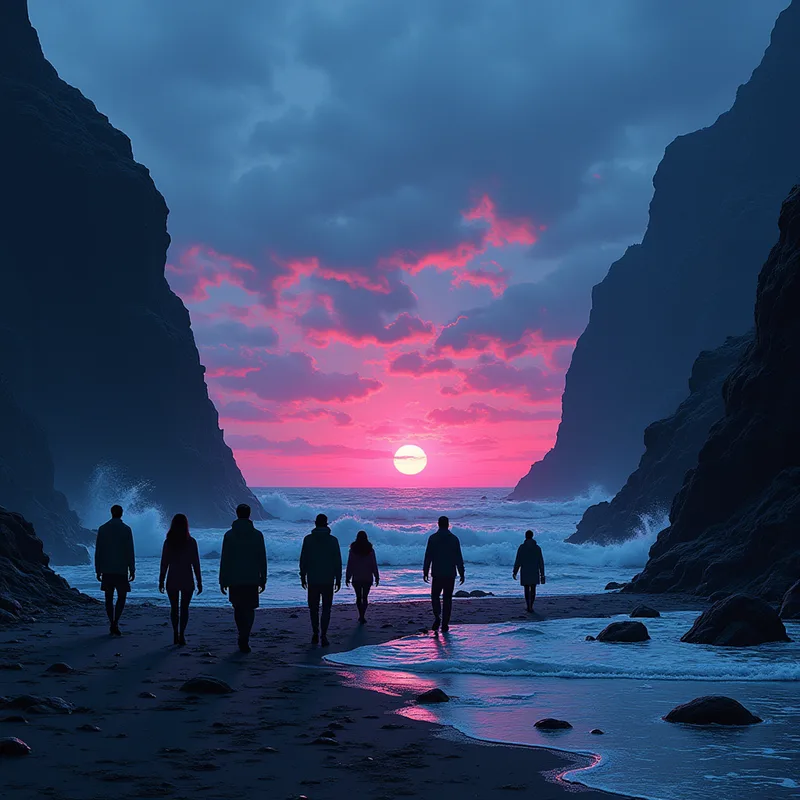
I want the record to keep the not-enough, because the not-enough is the one thing that made the five of us into the line of people who moved. A line of people who have looked and are satisfied stands until the air runs out. A line of people who have looked and are not satisfied walks. We had looked on the first morning, and the looking had not been enough. We went to the broken line the way a line goes to a thing: one at the front, and the rest of the line after, and the going was the first work of the new world, done the way work is done — without a plan, all five of us, in the order the sand put us in.
I will give the line its page, because the line is the record and the record is owed the line.
Rumzuck was the front. I want that plain, because the plain is the one thing the ninth page does not need to argue. He had been on one knee at the impact, and the knee had come up at some point I did not see, and the not-seeing was the whole of it, because a man who moves while you are looking at the sky is a man you will not be owed the seeing of. He walked the water's line the way he walks — not fast, with the shield on his arm and his hand on the boss, and the not-changing was the whole of him. He did not carry a weapon. He had no other, and the page will not spend the counting of his arms, because the page is owed the coast and not the ogre's inventory.
Behind him, and I will give the order, because the order is the record: Smackage a step back, with his palm an inch above the black sand as he walked — he did not put it on the sand, and the not-putting was the one thing I did not ask him to set down, because a man who walks over new ground with his palm an inch above it is a man who is listening before he is trusting. Zahlia at Smackage's shoulder, with her face still up, because the sky had been the same color from the impact to the broken line. Wreckreate behind them, three paces from the line — the three paces was the one thing the water had already put between him and the rest of us; he walked the line at a remove, the way a man walks beside a river he has not yet read. And me in the middle, holding the shape of the five, and the holding was the work, and the work was the one I do not set down.
The coast met us the way the coast meets everything. I will not spend the page on the way it breaks — the way it breaks is the work of the pages that come after the fire. I will spend the page on the one thing the broken line had that the rest of the new world did not.
The rock is a scar.
I want the record to keep the word, because the word is the one I have kept since the second morning. A scar is a thing that was a wound. A wound is a thing that was an opening. An opening is a thing that was a whole. I have stood at scars in the old world — the scars had names, and the names had the decency of a story told after the bleeding — and the scar of the broken line is the one scar I have seen that does not have a name. A scar that has a name is a scar the world has admitted. This one had not been admitted, and the not-admitting was the whole of the coast to me on the second day.
The scar is a seam.
And here the record has to be careful, because here is where the ninth page goes past the looking and into the seeing, and the seeing is the one thing I have not yet been allowed to forget. The seam runs in the color of cold light. I will give it the sentence it is owed, and I will not give it a longer one, because the longer one is the one that lies: the light that does not come from a place. The light that is a place.
The old world had light that came from a place, and the place had a name, and the name had a reason. I will not compare this to it, because the comparing is where the record would have to choose, and the record will not choose. I will say only this, and I will say it once: the seam glowed the way a vein of cold water glows in a deep place where the water has never seen a sun, and the glowing was not in the rock. A light that is not in the thing it is in is a light the thing is keeping, and the keeping was the one thing the broken line was doing that the rest of the new world was not doing.
It goes in the black rock the way a vein goes in stone, and the vein of this rock did not owe the stone anything, and the not-owing was the one part of the seam I did not like. It does not end where the rock ends. I stood where the rock ended and the water began, and the seam went under it, and the under was not a place I have been, and I will not tell you what I think is in it, because the thinking is where the world finds out.
The water is black. The water of the broken line is the color of the rock, and the rock is the color of the sky, and the three of them — the sky, the rock, the water — are the one thing that agreed with each other on the second day. The seam goes under the water, and the under is the one place the ninth page does not go, because the under is the work of a later page.
I stood at the seam with my hand near it and not on it.
I want that plain, and I want it at the end of the page, because the plain is the one thing the page keeps, and the keeping is the work. Not on it. I have put my hand on a great many things that were not safe, and the hand is the archmage's last word — the word the hand says when the mouth has given up the saying, and the last-word is the one the record keeps for the day it is needed. The hand went near the seam the way a word goes near a door that is not open. I felt the cold of it at an inch from the skin — not the cold of the well at the bottom of a long summer, because that cold had a shape and this one did not; this was the cold of a place that has not decided to be warm, and the not-deciding was the whole of the hand's part in the page.
It was not the day.
I put my hand back. I want the record to keep the putting-back, because the putting-back is the one thing the ninth page is about: not the seam, not the cold, not the under — the hand that came back. The hand is the last word, and the last word is the one you keep until the day it is needed, and the not-needed was the one thing the second day was, and the being-not-needed was the courtesy the world and I kept between us.
And here is what the ninth page owes you, and here is where I will spend it, because the spending is the whole of the page:
The rock was broken by a thing that was not a weapon.
I will say it once, and I will say it plainly, because the plainly is the one voice the camp has to build on, and the camp builds on the voice and not the voice on the camp. A weapon leaves a shape. I have stood at the work of weapons in the old world — the old world had weapons, and the weapons had shapes, and the shapes had the decency of a story told after the killing — and the shape of a weapon is a shape you can put your hand on, and the putting-on was the one thing I could not do on the broken line. This left a color. Not a shape. A color. The seam runs in the color of cold light, and the color is the one thing the thing that broke the coast did not take back, and the not-taking-back was the whole of the proof, because a thing that breaks a coast with a shape can be met, and the meeting is the work of the old world, and the old world is not here. A thing that breaks a coast with a color cannot be met the way a shape can be met, and the not-meeting was the one thing I have kept longest of the broken line, because the color is the one you do not talk about.
The talking is how it gets out.
I have learned that since, and the learning is the work of the pages that come after the fire. On the second day I only knew that the color was the one thing the world does not let go of, and the not-letting-go was the one thing the ninth page keeps, because a world that keeps its color is a world that means it, and the meaning was the one thing the broken line owed us on the second day, and the owing was the whole of it.
We came back to the fire with the not-enough in all of us, and the not-enough was the one thing the fire did not take, and the not-taking was the whole of the second day, because a fire that takes the not-enough is a fire of the old world, and the old world is not here, and the not-here was the one thing the five of us carried into the third morning.