Act I — The Crossing
Page 8 — Impact, the Shattered Coast
Black rock. Black sand. Kept air — the air that stays where it is put, the air of a world that has not decided to move yet. I will keep those three things in the record at the top of the page, because they are the whole of the eighth page and I will not let a page about the first ground of the new world lose its ground.
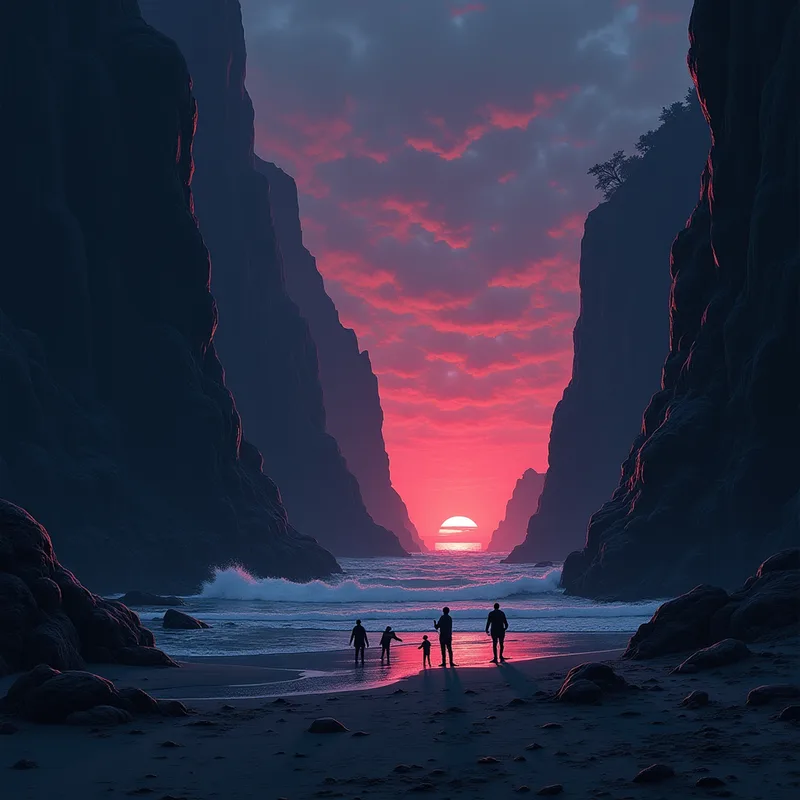
The landing was not a landing. I want the record to be exact about that, because the exact is the first courtesy the new world owes me, and I will not ask for a second. We came down the way a thing comes down when the world has already decided what it is. A stone dropped in a deep well. I have dropped stones in wells in the old world — the old world had wells, and the wells had depths, and the depths had the patience to take a stone — and the well takes the stone the way this world took us: the sound arrives before the stone does. We hit before the falling finished. In the old world a fall ends with a sound, and the sound is the body's part of it. Here, the ground took us without looking up, and the not-looking-up was the first courtesy we were not given.
We struck the broken shore of The Shattered Coast, and the shore took us the way the shore takes everything. I have seen this shore since — walked it, camped on it, buried nothing on it yet — and I will tell you the shore is the truest thing in this world, because it does not pretend to be anything that was not broken. The sand was the color of the inside of a shell that has been in the dark a long time. The rock was the color of a word that has been said too many times. Not black. I want the record to be careful: black is a color that has a reason, and this rock had no reason. It was the color of the saying. The air kept. I breathed it in on the first morning of the new world, standing on the black sand with my hands still open the way they had been in the white, and I will say this plainly, because the plainly is the whole of the first breath: it tasted of nothing. Not salt. Not the mineral nothing of a cave. The nothing of a thing that has never been anything — clean, empty, and patient. The nothing was the one thing it did, and the doing was the first of its manners, and I have learned the manners since, because a world that has manners is a world that means them, and this one means its nothing.
The five of us on the black sand at first light.
I say the five, and I do not count, because the counting is the work of the third morning. I will say only that I looked. Six went through the happening — I held the shape of the six, and I felt them in it the way a millstone feels the water that passes through it, all of it and no more than passes through — and on the black sand there were five. I looked at the four of them, and the four of them were there, and the there was the one part of the morning that behaved, and the behaving was not the part that sat down in my hand. The part that sat down in my hand was the fifth place in the shape I had held, and the fifth place was empty, and the emptiness was the one thing the happening had let through. I have held shapes in my life that were lighter than they should have been — I have held the shape of a city through a night I will not name, and the city came up short by a street, and the short was the thing I carried the longest of that night — and the short sat in my hand the way a stone sits in a hand: warm, real, and not yet a saying. I did not say it. I will say that on the page it belongs to. The eighth page is owed the looking, and the looking is all I will spend here.
The shore is the first page of the new world, and the new world had already begun without us. I want that plain, because the plain is the first thing I learned about it, and the learning is the whole of the eighth page. It was not waiting. I have crossed into things that were waiting — the old world had doors that were waiting, and the waiting had a shape, and the shape had a reason — and this was not that. There was no shape to it, and the not-shape was the one part of the morning I kept, because a world that has begun without you is a world you will have to join, and the joining is the work of the pages that come after the fire.
There was a gull, or something with the shape of a gull, on the black rock at the water's line. I want the record to be exact about the or, because the or is the first honest thing I have written on this page. It had the shape of a gull, the white of a gull, and the standing-at-the-water's-line of a gull. It did not look at us — five beings from a world it had not heard of, in a sky that had not been its sky a moment before — and the bird did not turn its head. I will say the not-turning plainly, because the plainly is the record: I was glad of it. A bird that looks at you is a bird that has counted you, and I did not want to be counted on the first morning. The gull flew the way a gull flies when the water has decided something about it, and the deciding was the one thing the new world had already done that we had not.
I looked at the four of them, and I will give them the page, because the four of them are the record, and the record is owed the four.
Rumzuck was on one knee, his hand already on the shield's boss. Already. I want the record to keep the already, because the already is the one thing I have kept longest of the ogre in this world. He had been down before the ground stopped moving under him, and the being-down was the one part of the landing the ogre did not owe anyone, and the owing was the one the record does not charge him. His hand was on the boss the way a man's hand is on a door that he is not yet sure is closed. He did not look at the sky. He looked at the water's line, and the looking was the whole of him that morning, because a man who looks at the water's line on the first morning of a new world is a man who has decided that the world will be taken from the shore inward, and the deciding was the one I agreed with.
Smackage was on the ground. Not kneeling this time — lying, with his cheek flat on the black sand and his palm flat on it, and the flat was the one thing the ground of the wrong ground did not change in him. The ground here is not the ground he reads — the sand here is the inside of a shell, and the inside of a shell does not speak the way his ground speaks — and he was listening to it the way you listen to a language you have not heard before, with the whole of the ear. He had not opened his eyes. I looked at the not-opening, and the not-opening was the one part of the morning I have kept, because the eyes will open when the ground is ready, and the ready is the work of the third morning.
Zahlia had her face turned up at the sky. Not looking. I want the record to be careful about the not-looking, because the not-looking is the one thing she does that is not a refusal. She had her face turned up the way a flower is turned up at a sun it has not met — not toward, but not away, and the not-away was the whole of it. There was no sun in that sky — the same color as the rock, and the same-color was the one thing the morning had that I did not like. She stood in it with her face turned up, and the standing was the one part of the morning that asked nothing of the world, because a woman who asks nothing of a new world is a woman who will give it the truest test it has, and the test is the work of a later page.
Wreckreate was already three paces from the water's edge. Already. I will keep the second already on the page, because the already is the one thing this world does to us: it makes us arrive late to our own decisions. He was standing at the line the water makes on the black rock, and his hands were at his sides, and the not-doing was the one I watched, because I know what the water will make him do, and the knowing is the work of the page that comes after this one. The water here was the color of the sky, and the sky was the color of the rock, and the three of them were the one thing that agreed with each other.
And me.
I stood in the middle of the five — the middle of the four and me, because the counting is the work of the third morning — with my hands still open. My craft under my ribs had gone quiet the way a bell goes quiet after the last of the striking — not silent, because a silent bell is a broken bell, and the bell under my ribs was not broken; it was kept. I held the shape of the story, and the shape was the four of them and me, and the having was the one I kept against the fifth place that was empty in it. I did not give the sixth place a name, because a name said on the first morning would be a name the world could hear, and the world has ears I have not yet met.
The shore was the first page, and the page was not blank.
I looked at the broken line of the coast and I began. Not the telling. The keeping. I began the keeping of the new world the way you begin a book you will write in a language you do not yet speak: with the first word of it, and the first word of it was the one that tasted of nothing.
The air kept. I breathed it, and the breathing was the one thing the new world and the five of us did together, and the doing-together was the whole of the first morning, because a world that breathes with you is a world that has not decided yet what you are to it, and the not-deciding was the one thing I was glad of on the black sand at first light, and the gladness was the one the eighth page keeps.