
Act IV — The Sleeping Water
Page 24 — The Camp Becomes a Place
First walls, first hearth, first ground that is theirs.
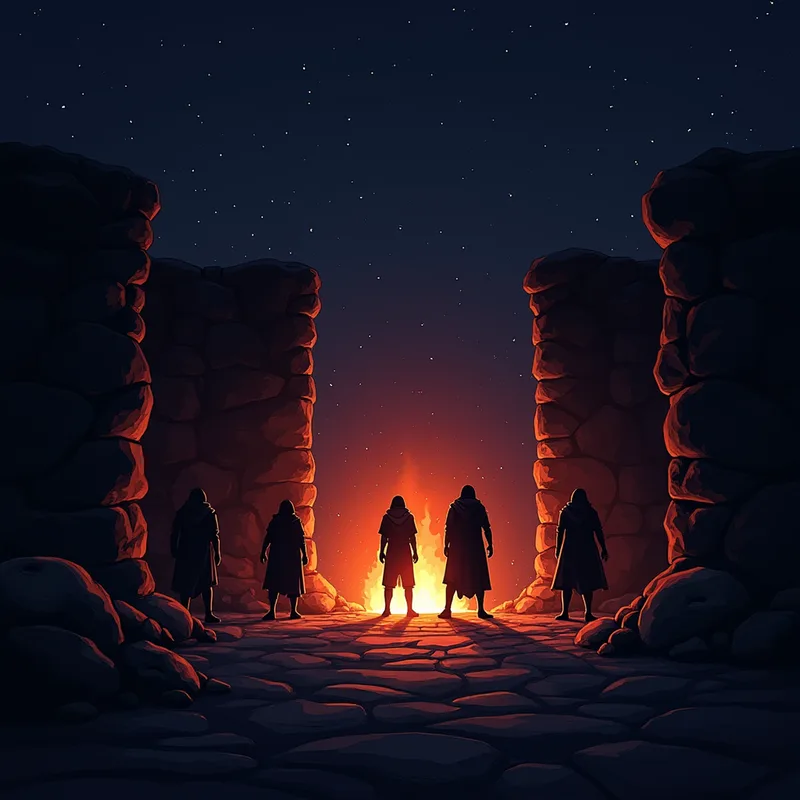
The building was the camp's part in the decision, and the part was what the decision kept for the camp on the fourth day. The decision was in the fire — the stay, the build, the send — and the three parts were the camp's part in the finding. The stay was the part that kept the camp, and the keeping was what the camp owed the stay. The build was the part that made the place, and the making was the build's part in the camp. The send was the part that kept the finding, and the keeping was what the camp owed the kept place. The fire held the three parts while the camp did.
We built it the way the old world taught it.
The teaching was the one the old world kept for the camp — the way the six of us had built a hundred camps in a hundred ruins in the last of the old world, and the hundred were the old world's part in the building. The six of us built the camps the way the six of us built them — with the craft under the ribs, and the craft went to work the way the craft goes to work in the building: not in the building, and the not-in was the craft's part in the holding. The building was the camp's part in the old world, and the old world did not let go of it through the hundred ruins.
The walls were black rock, set dry.
The black rock was the rock the coast gave the camp, and the giving was the one the coast did not let go of. The setting-dry was the way the coast's own walls were set, and the setting-dry was the coast's part in the building: the coast's walls were set dry the way the coast's walls are set, and the not-mortared was what the coast did not let go of through the coast's own part in the world. The coast's walls were the first instruction, and the instruction was what the coast owed the camp — the instruction that said the walls are set dry. We did not have the arrogance to improve on them, and the not-having was the camp's part in the instruction: the camp that has the arrogance to improve on the coast's walls is the camp the coast has finished with.
The setting took the morning of the sixth day, and the morning was the one the camp gave the building.
I will say that in the plain voice, because the record is owed the morning: the black rock was where the black rock goes — the line where the water comes in, the place the coast kept for the camp's part in the water. The rock took the light the way the coast takes the light, without looking up, and the without-looking-up was the rock's part in the morning. The six of us set the rock the way the six of us set it — Rumzuck at the place the ogre keeps, his hands on the grip while the ogre's part of the wall was the ogre's part in the building; Smackage on the ground where the ground's part of the camp is, his palm on the sand while the ground's part of the wall was the ground's part in the building; Wreckreate at the water's line, because the water's part of the wall was the water's part in the building, and the water-reader did not leave the line of the water to set the wall; Zahlia a little back from the fire, her hands where the air's part of the wall is; and me at the craft's part of the wall, where the craft's part of the building is. The six of us set the rock, and the setting was the camp's part in the morning, and the part was the one the camp did not let go of.
The walls mean rooms.
The rooms were the camp's part in the building, and the part was what the building owed the camp. The walls make the rooms the way the walls make them — the inside of the wall is the room, and the inside was the room's part in the building. The rooms mean corners, and the corners were the camp's part in the rooms: the four corners of the camp, and the four corners were the camp's part in the building. The corners were given the way the old world gave them, and the old world did not let go of the giving through the hundred ruins.
Wreckreate took the corner by the water.
The corner was the water-reader's part in the camp, and the part was what the water owed the water-reader. The water is his to read, and the reading was the water's part in the camp: the water the fourteenth page had read as a copy of the flowing, and the copy was what the water did not let go of. The corner by the water was the water's part in the building. He took it the way the water-reader takes the thing the camp is owed — without a word, and the not-word was his part in the taking. The corner was his, and the being-his was the corner's part in the camp.
Smackage took the corner with the best ground.
The best ground was the ground's part in the camp, and the part was what the ground owed the camp. The lid was thinnest there, and the thinnest was the ground's part in the corner: the lid under everything, the lid the fourteenth page found under the rock, and the under-the-rock was what the ground did not let go of. The ogre took the corner the way the ogre takes everything — without getting up, and the not-getting-up was his part in the taking. His palm was flat on the ground where the ground's part of the camp is, and the flat was the ground's part in the corner.
Zahlia took the corner where the Veil was thinnest.
The thinnest was the Veil's part in the camp, and the part was what the Veil owed the camp. The Veil was the wall that reads back, and the reading-back was the Veil's part in the world: the hand that was not hers, the sixteenth page's part in the Veil, and the not-hers was what the Veil did not let go of. She said the thinning was not an improvement, and the not-improvement was her part in the saying: the Veil that is thinnest is the Veil that reads back the hardest. I did not argue, and the not-arguing was the archmage's part in the camp — the archmage who does not argue with the Veil's part in the corner.
Rumzuck took the corner in front of the door.
The door was the camp's part in the building, and the part was the one the door owed the camp. The front was the one he keeps, and the keeping was the ogre's part in the camp: the line that does not leave the line, the fifteenth page's part in the ogre, and the not-leaving was what the ogre did not let go of through the old world. He took the corner the way the ogre takes everything — his hands folded over the grip, the folded was the ogre's part in the taking. The corner in front of the door was his.
And the sixth corner — the one by the hearth, set a little back from the light — we kept.
The sixth corner was the kept place's part in the building, and the part was what the camp owed the kept place. We did not give it. The not-giving was the camp's part in the corner: the corner by the hearth, set a little back from the light, and the back-from-the-light was the one the camp had not moved since the white. The kept place was the one by the fire. We did not give the corner, and the not-giving was the first of the new world — the first of the camp's part in the new world, and the first was the camp's part in the building. The keeping was the first of the new world, and the camp kept it for the kept place, and the kept place kept it for the one who is not here.
The hearth was in the center.
The center was the camp's part in the building. The hearth was the fire, and the fire was the one thing that was ours: the fire the camp had kept since the first night on the broken coast, and the keeping was the fire's part in the camp. The fire was the one thing the camp had that the world did not have, and the not-having was the world's part in the camp — the world does not have the fire the camp has. The hearth was in the center: the fire in the middle, where the fire goes, and the middle was the one the camp owed the fire.
The camp is no longer something we are in. It is something we are.
I will say that in the plain voice, because the record is owed the no-longer: the camp was something the six of us were in, and the being-in was the camp's part in the old world. The camp is something the five of us are, and the being was the camp's part in the new world. The walls are up, and the being-up was the camp's part in the building. The hearth is in the center, and the being-in-the-center was the fire's part in the camp. The corners are given, and the being-given was the camp's part in the corners. The sixth corner is kept, and the being-kept was the camp's part in the kept place. The five becomings were the camp's part in the building, and the sixth day kept them for the kept place, and the kept place kept them for the one who is not here.