
Act III — The Split
Page 17 — The Night Watch
The night watch.
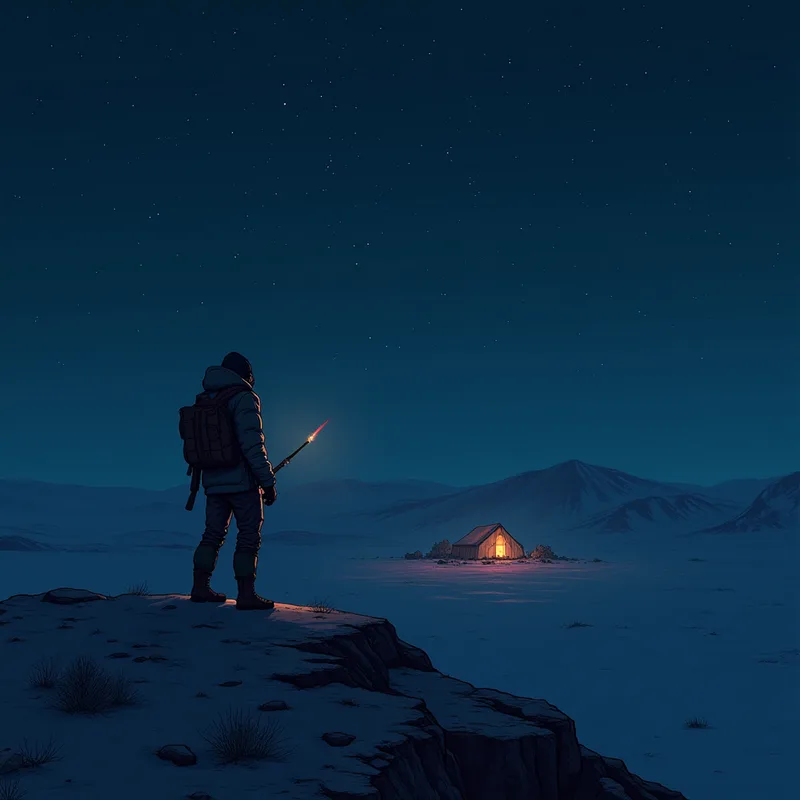
A camp that does not keep the watch is not a camp but a pile of wood with a fire in it. The old world taught this before it taught the craft: two at a time, four hours, the fire kept low enough that the dark can see the fire and not the camp. The old world's camp slept under the dark the way the dark wanted to be slept under, and the wanting was the whole of the old world's night. The camp is quiet the way the camp goes quiet after the fire is done with the day — the pots put down, the water carried in, the day's work put back where the day's work goes. The teaching is in the record: two at a time, four hours, the fire low.
The fire is in the middle, where the fire goes.
The camp was laid the way the camp gets laid — the fire in the middle, the water's place at the line where the water comes in, the seam where the ground does not meet the ground, and the ring of the five of us around the fire. The water's place is the one Wreckreate reads, the seam is the one Rumzuck looks at, and the ring is the one the night keeps for the five. The five of us are in the ring the way the five of us were in the ring in the old world — not a circle of equals but a ring of work, each of us at the place the work has us: Rumzuck with his back to the dark that has the water in it, Wreckreate at the water's line with his hands where the water's part of the camp is, Smackage with his palm on the ground where the ground's part of the camp is, Zahlia near the fire where the air's part of the camp is, and me at the fire where the craft's part of the camp is.
The laying made no place for the sixth. I have looked for it since the night the world split the party, and the looking is the work of the record: there is no place for the sixth in the camp, and the not-place is the one the camp kept for the sixth — the keeping is the thing the camp does not say out loud.
Rumzuck took the second watch.
The ogre took it the way the ogre takes everything — without a word. The ogre's hands went to the grip, and the grip was the one thing the night owed the ogre. I have known that grip since the first morning of the old world, when I stood behind the ogre in a dark that was still the old world's dark and watched him hold the line through it the way the ogre holds it through the light — the same hands, the same not-moving, and the two samenesses were the whole of the ogre's part in every fight I have ever known. The ogre sits down with his shield on his knee, and the sitting-down was the whole of the ogre's way of taking a watch — no ceremony, no word, the shield where the shield goes and the ogre where the shield has him. His face is the face of a man who has already finished the night and is waiting for the rest of it to catch up. The ogre does not take a watch. The ogre keeps the line, and the keeping was the whole of the second watch.
I took the first.
The first watch is the watch the camp builds on, and the one the archmage owes the camp. The taking stands on its own here: the first watch is the one the camp builds on, and the building-on was the whole of the taking. I sit at the fire with the craft under my ribs — not a weapon, not a ward, the craft itself, the way the craft goes to work in the dark. The archmage's work is the one that does not lie. The not-lying is the one thing the craft owes the night, and the owing was the work of the night on my hands, and the work is the one the record has.
The night was the night.
The night did what nights do. The stars came out — the new world's stars, in the wrong places, and the wrong-places is the thing I have not stopped doing: looking up at them and not finding the old world's sky where the old world's sky should be. I have kept them since the first night on the broken coast. The wind comes off the water with the smell of the water in it, and the smell was the water's part in the night. The cold comes down off the coast the way the cold comes down off the old world's coasts — slow, and all the way down, the way the cold goes when the coast means it. The night was the night.
And what was not right.
Not in any way I could point to. Not in any way I could test — the testing was the work of the twelfth page, and the work is owed its page. I could not put my hand on it the way I put my hand on the air. Just a wrongness. It is the way a room is wrong when someone has moved a thing in it and put it back — everything is in the right place and the room does not fit the places. I have felt it in a room in the old world, and the feeling was the whole of the wrongness to me, and the whole is the thing I have kept since. The night has that in it.
The way a word in a letter is the wrong word, and the letter is otherwise in the right hand. A letter in the right hand is a letter where every word is the right word; a letter with one wrong word in it is a letter where every word is right except one, and the except-one is the one I felt on this night: the night was the right hand, and the night had one word in it that was not the night's word, and the not-night's word is the one I kept against the four hours.
I watched the fire. The fire watched the dark. The dark watched back.
I will keep the three of them, because the three are the thing the record is owed. The dark in the old world did not watch — the dark in the old world was, and the being was the whole of the dark to the old world's camp, and the whole is the one the old world's camp slept in. The dark here watches, and the watching is the thing the new world keeps for its dark. The not-naming was the whole of the four hours.
I did not say it to the four of them.
They are in the ring the way the camp was laid — Rumzuck with his shield across his knees, the ogre's breathing slow the way the ogre's breathing goes slow, and the slow was the ogre's sleep. Wreckreate on his side, his hands folded over his face the way Wreckreate sleeps when the water has been against him all day. Smackage where Smackage goes — flat on the ground, his palm on the ground even in the sleep, the lid under everything even when the lid is not being read. Zahlia near the fire, her hands in her lap, and the hands were still the way the hands go still when the air has done its part for the day. They were asleep, and the asleep was the thing the camp owed the night. The not-saying was the courtesy the watch owes the sleep, and the one the old world's camp kept for the sleep. A watch does not wake the camp for a wrongness the watch cannot name — the not-waking is the one the old world taught, and the one I kept on my mouth through the four hours.
At the end of the four hours, the fire was low.
The fire was low the way the fire is low at the end of the watch — the coals where the coals go, the wood where the wood goes, and the dark where the dark goes. I put a log on the fire the way the old world's watch put a log on the fire — the watch's work at the end of the watch is one log, and the log is the thing the fire owed the dark. The coast was the color of the inside of a shell that has been in the dark a long time. I have held a shell like that in my hand, in the old world, on the old world's shore, and the holding was the whole of the color to me. The inside of the shell keeps the color where the light has not been, and the whole is the one the coast had on this night.
I went to the water's edge.
I did the thing I have done a thousand times in a thousand sanctums — the asking, the one the old world taught me there, and the one the thousand sanctums owed the asking. A priest does the asking when the priest has finished the day and the day is owed the night's part in it. I stand at the water's edge the way I have stood at the water's edge a thousand times — the water in front of me, the coast behind me, and the asking where the asking goes. The water does what the water does; the new world's water, and the coming-in was the thing the fourteenth page kept for the water's part.
I asked — not the night. I asked the way the asking is asked. I will not write down the shape of the asking, because the shape is not a thing the record can keep — the not-keeping is the one the thirteenth page kept for the asking, and the one this page has kept since.
The night did not answer.
The night is not a god, and the not-a-god is the thing the night owes the record: the thirteenth page found the gods here and not answering, and the not-answering was the whole of the thirteenth page. The night is the night, and the being-the-night is the thing the world owes the night. But the silence it gave me was the same silence the hall of seals had given me — the silence of the room where someone has been and is not, and the is-not is not a going-away. The night is not a god, and the night gave me the god's silence. The same is the one the world does not let go of.
The eighteenth page is owed the dawn — the dawn the night owes the camp.