
Act III — The Split
Page 15 — Rumzuck's First Words
The ogre spoke.
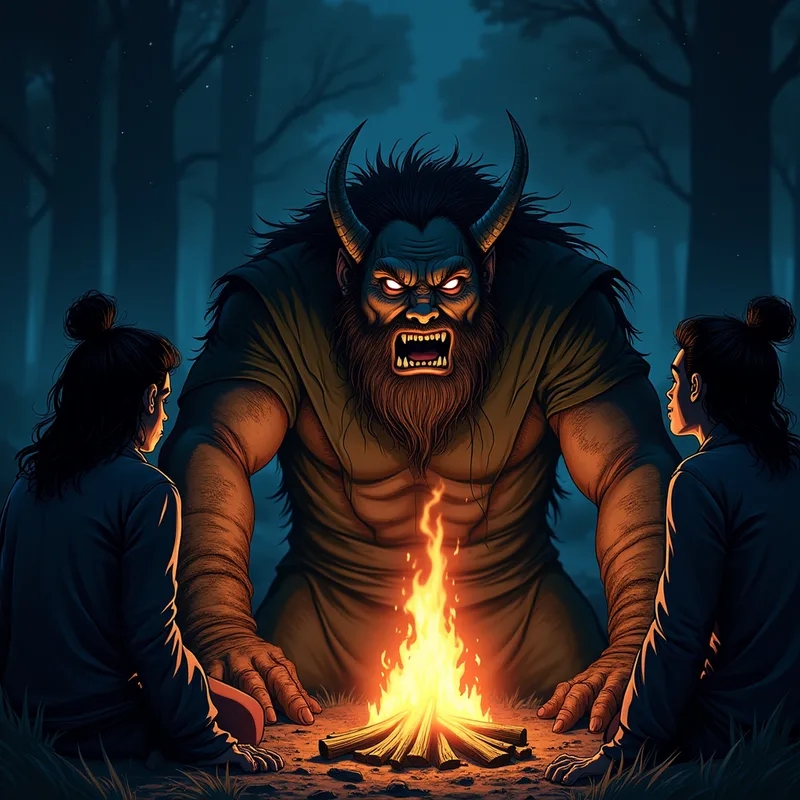
It was the first of his words in the new world, and the first is the one the record keeps. The record keeps the firsts — the first smoke, the first fire, the first wrong, the first asking that got no answer — because a record that keeps the firsts keeps the whole story in them. That is the work of the fifteenth page and every page after it.
The ogre had been quiet all morning.
I will not tell you how long. I will tell you what he was doing while he was quiet, because the doing is the record. He had been by the fire, his shield on his back, his hands folded over the shield's grip the way he folds them when he is thinking.
An ogre's thinking is not a stillness.
I have the practice of the difference, and the difference is the one the old world taught me on the ogre's face. A stillness is a thing that has stopped. A keeping is a thing that has not stopped and is not going. The ogre's thinking was the keeping, and the keeping was the one the fire could not warm. I have watched that fire warm things that are not ogres, and the difference is the record's: the fire warms what it touches, and the ogre's thinking was not what the fire touched.
The shield's boss was under his palms.
The boss is the part of the shield that has taken the blows. I have held a shield behind the ogre's, and the holding is the work of the old world on my hands: the boss takes the blows that would go through, and the taking-the-ones-that-would-go-through was the whole of the boss to me. The ogre keeps the boss the way he keeps everything — with his hands on it. The boss was under his palms all morning, and the palms were the ogre's whole argument, and the argument was the one he had been making with the fire. The fire was the one the argument was against, and the against was the whole of the quiet.
He did not look at any of us.
When he spoke, he was looking at the seam in the rock. The seam runs up out of the black sand at the foot of the broken coast, thin as a word, and the cold light runs in it. I have watched it since the second night. The light in the seam is not the light of the new world's sky. The sky gives its light down and over, the way the old world's sky gave its light, and the light in the seam runs — along, and along — the way a word runs when the word is being said by a mouth that is not looking at you.
The ogre looked at the seam the way the ogre looks at everything.
The rest of us look at a thing to find out what the thing is. The ogre looks at a thing to find out what the thing has done. When the rest of us look at a wall, we are asking the wall what it is made of. The ogre is asking the wall what it has been hit by. I have known the ogre since the first morning of the old world, and the long knowing is the work of the old world on me. The ogre had been doing that asking at the seam all morning, and the all-morning was the whole of the quiet.
The scar is new.
The ogre said it the way he says everything — low, and once, and with the whole of the ogre in the saying. The scar is new. Four words, and each one a place, the way a smith puts the hammer on the metal — not swung at it, put on it. The. Scar. Is. New. Four places, four words. I have seen the ogre work at a forge, and the seeing is the work of the old world on my eyes: the smith does not swing. The smith puts. And the ogre had put his four words on the seam.
The four of us looked at him.
The looking was the whole of the camp for a moment — the fire, the black sand, the seam, the light running in it, and the ogre who had spoken four words and used them the way a smith uses a hammer.
New for a world this old, he said. I have seen old scars. I have carried old scars. This one has not had time to be old.
New. The rest of us say new the way we say it — the thing is new, and the new is the whole of the saying. The ogre says new the way a smith says the metal is new: the metal has not been worked. The scar has not had the time that the old world's scars had — the time of the weather, the time of the water, the time of the stone moving against the stone. The three times were the whole of the old world's scar-work, and the scar here had not had them. Not-had-time. I want the record to keep the not-had-time, because not-had-time is the ogre's worst word. It is what he says when the thing has not had the time that the thing is owed, and the ogre says it low, and once, and with the whole of the ogre in it.
I have seen the scars on the ogre, and the seeing is the record's: the scars on his back are the old world's work on him, and the work is the whole of the ogre's back to me. He had seen old scars on things bigger than himself — on the walls of the old world's fortresses. The ogre knew what an old scar was the way the smith knows what cold iron is — by the hand. And the hand had put new on this one.
The world that made it is still here, or it is coming back, and the coming back is not a thing you argue with.
The two. Still here. Or coming back. The ogre gives the camp the two the way he gives the camp everything — the whole of the saying. Still here: the maker is in the world, and the being-in-the-world was what the maker owed the world. Or coming back: the maker is not in the world, and the not-in-the-world was what the maker owed the away. The ogre put the still-here on the seam with his eyes, and the coming-back on it with the rest of his voice, and the or was the one thing between them.
I stood in the middle of the camp. The ogre's two were the whole of the morning, because they were the one thing the camp had not had since the second night — a word that was not about the camp. Every word since the second night had been about the camp: the cold, the smoke, the water, the sand, the planes, the seals, the copy, the lid. The camp's words were about the camp. The ogre's two were about the maker. The maker was the one thing the camp had not spoken since the second night, and the not-speaking was the whole of the camp's silence. The ogre broke it with his two.
And the last part — the coming back is not a thing you argue with — he said the way he says everything, which is to say he had already finished the argument and was waiting for the rest of us to catch up. The ogre has been in arguments the way he has been in fights: on the front. But the ogre does not argue a thing with the thing. The ogre argues a thing with the rest of the people who are going to have to live with the thing, and the living-with was the one thing the ogre owed the camp.
I looked at the seam.
I looked at the four of them.
I looked at the seam the way the ogre had looked at it, and the looking was the work of the ogre on my eyes. The seam was the seam. The light was running in it. The ogre had put a new on it, and the new was the whole of what I saw when I looked. Then I looked at the four of them — Rumzuck with his hands on the boss, Smackage with his palm an inch above the sand, Zahlia with her face up, Wreckreate at the line where the water comes in — and the four were the whole of the camp's part in the looking.
The ogre who has held the line in every fight I have ever known had looked at the scar in the rock and found it young.
I did not say what I was thinking.
I did not say it to the camp, because the camp had not asked. And I will not say it to the record, for the same reason. I have kept the not-sayings since the fourteenth page, and the keeping is the work of the record on the not-sayings.
I will say it once, here, where the record keeps it:
The world had made that scar with something the size of a god. And the making was not a thing you argue with either.